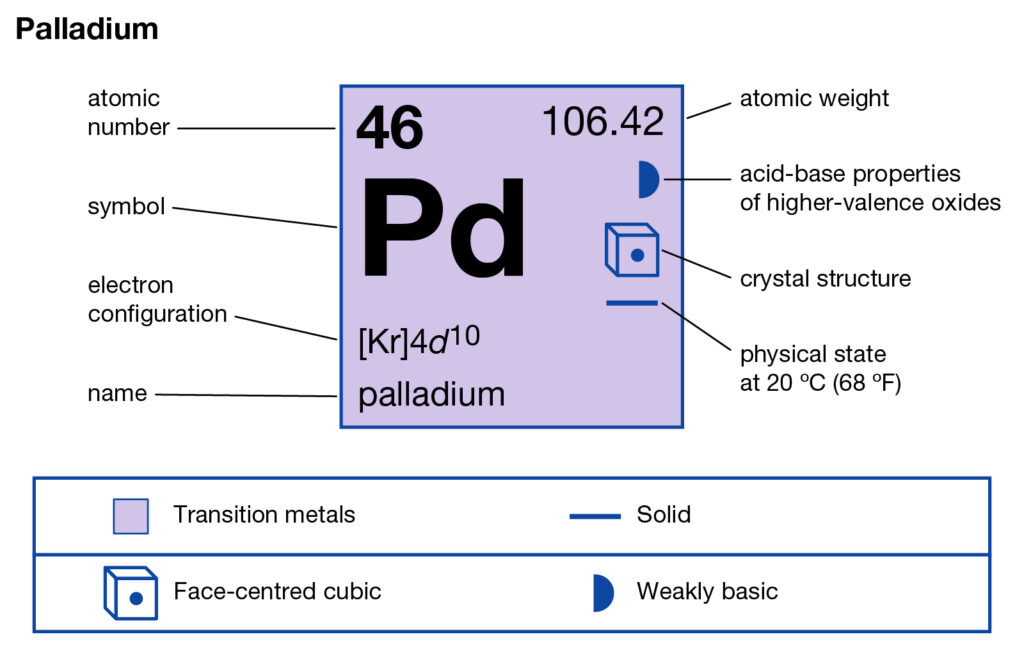
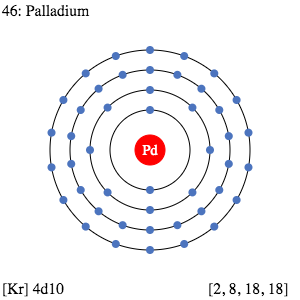
Palladium Electron Configuration: The electron configuration of Palladium (Pd) explains how the 46 electrons of this transition metal are arranged in different atomic orbitals. Understanding the Pd electron configuration helps students, chemists, and researchers predict its chemical behavior, bonding, oxidation states, and reactivity. In this guide, you’ll learn the ground-state electron configuration of Palladium, orbital notation, noble gas shorthand, valence electrons, and why Pd has an unusual electron arrangement.
- Bromine Electron Configuration
- Sodium Electron Configuration
- Magnesium Electron Configuration
- Aluminum Electron Configuration
- Silicon Electron Configuration
- Sulfur Electron Configuration
- Chlorine Electron Configuration
- Phosphorus Electron Configuration
- Argon Electron Configuration
- Potassium Electron Configuration
Today we are going to discuss the electron configuration of Palladium chemical element in this article.
Palladium Electron Configuration
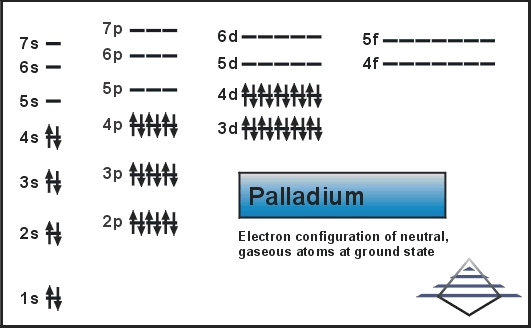
Palladium (Pd) is a rare, silvery-white transition metal with atomic number 46 on the periodic table. It was discovered by William Hyde Wollaston in 1803 and belongs to the platinum-group metals. Due to its outstanding catalytic properties, corrosion resistance, and excellent electrical conductivity, palladium is widely used in catalytic converters, electronics, jewelry, dentistry, hydrogen storage, and industrial chemical processes.
What is The Electron Configuration of Pd?
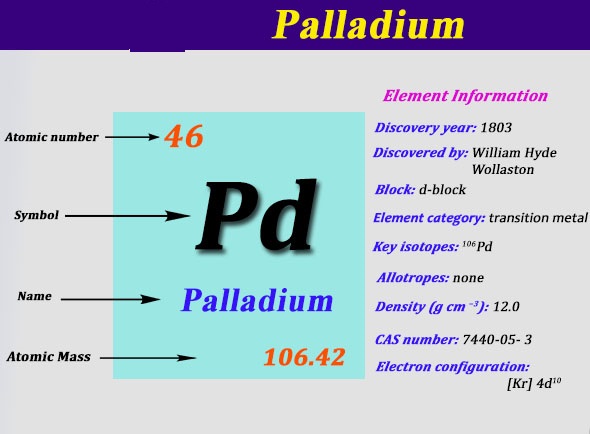
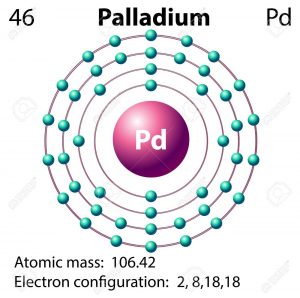
The Palladium element has the 46 electrons you can refer to the periodic table to calculate that and we further know about the S orbital, which can only retain the maximum 2 number of electrons. Further P can hold 6, d can hold 10 and the f can at last hold 14. With this equation the electron configuration becomes as 1s2 2s2 2p6 3s2 3p6 3d10 4s2 4p6. .
Further filling the 4th shell in order to make the atom at the optimum point of stability this equation becomes [Kr] 4d10.
How Many Valence Electrons Does Palladium Have?
The Palladium basically has the 10 valences of the electrons which it holds in its outermost shell also known as the 4d shell. Here in this theory of having the 10 valence of electrons the palladium follows the octet rule. This rule is followed by any chemical element which holds 8 or more electrons.
Palladium Number of Valence Electrons
The palladium basically holds the 18 Electrons in the outermost shell and it is because of the metal electrons interaction which is considered to be very complex. The other reason for having the 18 Electrons by the palladium is due to the pseudo inert gas configuration nature of the palladium.
FAQs
Q1. What is the electron configuration of Palladium (Pd)?
A: The ground-state electron configuration of Palladium (Pd) is [Kr] 4d¹⁰ 5s⁰. It is one of the few transition metals with an empty 5s orbital.
Q2. Why is Palladium an exception to the Aufbau principle?
A: Palladium transfers its two 5s electrons into the 4d subshell, creating a completely filled 4d¹⁰ configuration, which is more stable than 4d⁸ 5s².
Q3. What is the atomic number of Palladium?
A: The atomic number of Palladium is 46, meaning a neutral palladium atom has 46 protons and 46 electrons.
Q4. Is the electron configuration of Palladium important for exams?
A: Yes. The electron configuration of Palladium ([Kr] 4d¹⁰ 5s⁰) is one of the most frequently tested electron configuration exceptions in board exams and competitive exams such as JEE, NEET, SSC, and UPSC.