Aluminum Valence Electrons: Aluminum (Al) is a lightweight, silvery-white metal with the atomic number 13 and an atomic weight of 26.9815. Known for its excellent strength-to-weight ratio, corrosion resistance, and high recyclability, aluminum is one of the world’s most widely used non-ferrous metals. It naturally occurs in minerals and rocks, especially bauxite ore, rather than in its pure form. Thanks to its durability, conductivity, and rust-resistant properties, aluminum plays a vital role in modern industries, manufacturing, and everyday applications.
- Flerovium Valence Electrons
- Moscovium Valence Electrons
- Livermorium Valence Electrons
- Tennessine Valence Electrons
- Oganesson Valence Electrons
- Nobelium Valence Electrons
- Neptunium Valence Electrons
- Plutonium Valence Electrons
- Americium Valence Electrons
- Gold Valence electrons
- Mercury Valence electrons
- Lead Valence electrons
- Bismuth Valence electrons
- Radon Valence electrons
- Radium Valence Electrons
- Antimony Valence Electrons
- Tellurium Valence Electrons
- Iodine Valence Electrons
- Xenon Valence Electrons
- Caesium valence electrons
The melting point of the aluminum is 660 °C and the boiling point is 2,467 °C. Aluminum also presents in some gemstones like topaz, garnet, and chrysoberyl.
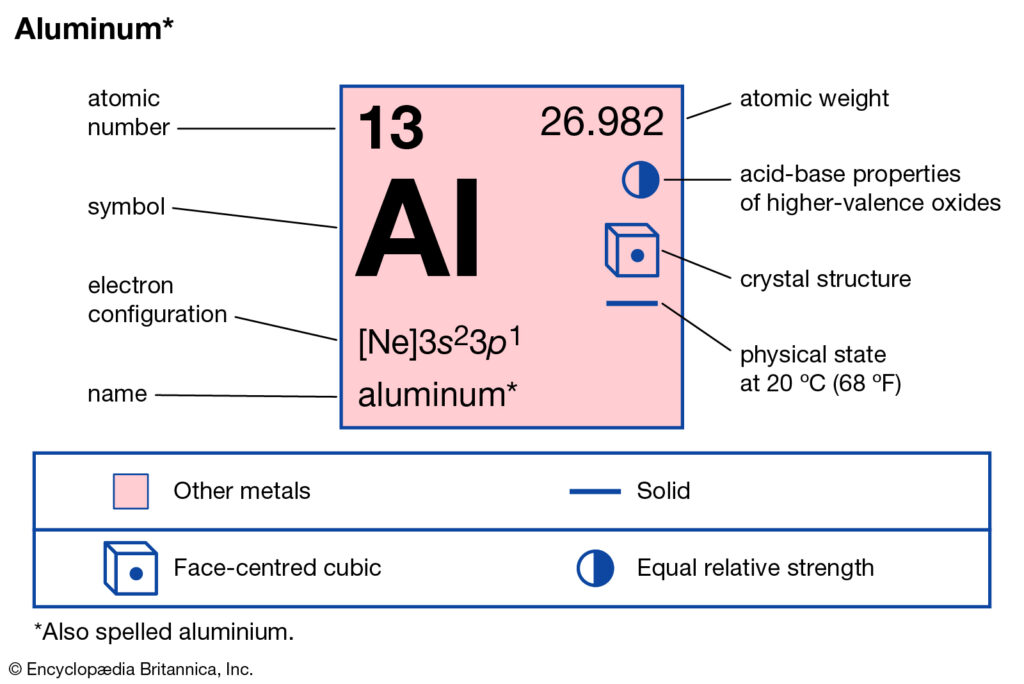
The Egyptians and the Babylonians were among the earliest civilizations to use aluminum compounds in medicines, cosmetics, and chemical applications. Today, aluminum is one of the world’s most widely used metals because of its lightweight, durable, corrosion-resistant, and recyclable properties. It is commonly used in aircraft manufacturing, construction materials, refrigerators, air conditioners, cooking utensils, electrical wiring, automotive parts, and food packaging. There are different types of aluminum, including soft aluminum, which is lightweight and easy to shape, and high-strength aluminum alloys made by combining aluminum with elements such as silicon and iron to improve durability, strength, and performance for industrial and commercial applications.
Aluminum Valence Electrons Dot Diagram
The electron valence dot structure or diagram always shows or represented as the number of electrons for that particular element in the form of dots. Aluminum comes in the group third of the periodic table. And has three valence electrons. And the structure is surrounded by the three total dots in which one is located at the top of the symbol. Second dot is located below the symbol, and the third dot is located in the right side of the symbol. Here, is the dot diagram you can see and learned properly with the help of this diagram.
Valency of Aluminum – Al
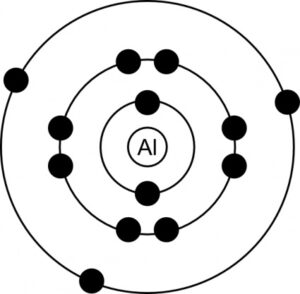
Aluminum is a type of metal. The valency of the aluminum is 3 as the number of electrons in the outermost shell of the element is 3. So, the total valency of aluminum is 3.
FAQs
Q1. How many valence electrons does aluminum have?
A: Aluminum has 3 valence electrons. Its electron configuration is [Ne] 3s² 3p¹, meaning the three electrons in the outermost energy level participate in chemical bonding. These valence electrons make aluminum highly reactive and capable of forming stable compounds.
Q2. Why does aluminum have 3 valence electrons?
A: Aluminum belongs to Group 13 of the periodic table. Elements in this group naturally have three valence electrons in their outer shell. This atomic structure allows aluminum to lose these electrons easily and form Al³⁺ ions, making it useful in industrial and chemical applications.
Q3. What is the Lewis dot structure of aluminum?
A: The Lewis dot structure of aluminum is represented by the symbol Al with three dots placed around it, each dot representing one valence electron. This simple diagram helps students understand how aluminum forms chemical bonds and participates in chemical reactions.
Q4. Why are aluminum valence electrons important?
A: Aluminum valence electrons determine the metal’s chemical properties, bonding behavior, conductivity, and reactivity. They explain why aluminum forms compounds like aluminum oxide (Al₂O₃), resists corrosion through a protective oxide layer, and is widely used in construction, electronics, aerospace, packaging, and electrical wiring.
Conclusion
Understanding aluminum valence electrons is essential for learning atomic structure, chemical bonding, and periodic table trends. Aluminum has 3 valence electrons, which enable it to form stable compounds and lose electrons to create Al³⁺ ions. Its electron configuration and Lewis dot diagram make it easier to visualize how aluminum reacts with other elements. Whether you’re studying chemistry, preparing for exams, or exploring the properties of metals, knowing the number of aluminum valence electrons, electron configuration, Lewis dot structure, and chemical properties provides a strong foundation for mastering this important element. This knowledge is especially valuable for students, educators, and anyone interested in chemistry and material science.
Leave a Reply