Have you ever wondered how many valence electrons iron (Fe) has or why iron shows more than one valency? Iron is one of the most important transition metals and plays a vital role in construction, biology, manufacturing, and chemistry. Unlike many elements that have only one common valency, iron can exist in multiple oxidation states, making it highly versatile in chemical reactions.
In this guide, you’ll learn everything about iron valence electrons, iron valency, electron configuration, oxidation states, and the valency of iron in Fe₃O₄, with simple explanations and examples.
- Flerovium Valence Electrons
- Plutonium Valence Electrons
- Mercury Valence electrons
- Neptunium Valence Electrons
- Moscovium Valence Electrons
- Cesium valence electrons
- Bismuth Valence electrons
- Silicon Valence Electrons
- Livermorium Valence Electrons
- Radon Valence electrons
- Xenon Valence Electrons
- Tennessine Valence Electrons
- Antimony Valence Electrons
- Radium Valence Electrons
- Oganesson Valence Electrons
- Lead Valence electrons
- Tellurium Valence Electrons
- Gold Valence Electrons
- Nobelium Valence Electrons
- Hydrogen Valence Electrons
- Phosphorus Valence Electrons
- Helium Valence Electrons
- Lithium Valence Electrons
- Americium Valence Electrons
- Beryllium Valence Electrons
- Boron Valence Electrons
- Sodium Valence Electrons
- Carbon Valence Electrons
- Nitrogen Valence Electrons
- Aluminum Valence Electrons
- Oxygen Valence Electrons
- Iodine Valence Electrons
- Fluorine Valence Electrons
- Magnesium Valence Electrons
- Neon Valence Electrons
- Sulfur Valence Electrons
If the number of electrons in an atom is less than or equal to four, the number of valence electrons is equal to the number of electrons in its outer shell. If it is more than four, it is eight minus the number of electrons in the outer shell.
Iron Valence Electrons
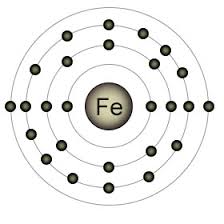
Iron has an atomic number of 26. The valence electrons can vary from -2 to +6, but the most common valency it exhibits is +2 and +3.
Iron Valency & Electron Configuration

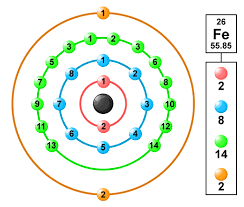
Iron (Fe) is a transition metal with the atomic number 26. One of its unique characteristics is its variable valency, meaning it can form ions with different oxidation states depending on the compound. The most common oxidation states of iron are +2 (ferrous) and +3 (ferric), making it highly reactive and useful in a wide range of chemical reactions.
For example, in ferrous sulfate (FeSO₄), the sulfate ion (SO₄²⁻) carries a −2 charge. To keep the compound electrically neutral, iron must have a +2 oxidation state. Therefore, the valency of iron in FeSO₄ is +2.
Electron Configuration of Iron (Fe)
The electron configuration of iron is:
1s² 2s² 2p⁶ 3s² 3p⁶ 4s² 3d⁶
or in noble gas notation:
[Ar] 3d⁶ 4s²
This electron arrangement gives iron 8 valence electrons (considering both the 3d and 4s orbitals involved in bonding), allowing it to exhibit multiple oxidation states. This is why iron commonly forms compounds such as FeO (iron(II) oxide), Fe₂O₃ (iron(III) oxide), FeSO₄ (ferrous sulfate), and FeCl₃ (ferric chloride).
What is the Valency of Iron in Fe3O4
How many valence electrons does iron have?
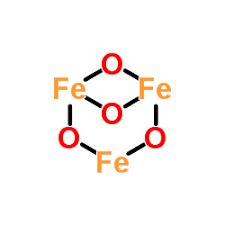
Oxide ions tend to have a 2- charge. The overall charge of Fe3O4 is 3(Fe) + 4(-2) = 0, which means that the valency of iron in Fe3O4 is +8/3. But since having fractional valencies is not possible (you can only lose a whole number of electrons, but not fractions of an electron), this is only an average valency for the iron atoms in Fe3O4.
Frequently Asked Questions (FAQs)
Q: How many valence electrons does iron have?
A: Iron has 8 valence electrons when considering the 3d and 4s electrons involved in chemical bonding.
Q: What is the most common valency of iron?
A: The most common valencies are +2 (ferrous) and +3 (ferric).
Q: Why does iron show variable valency?
A: Iron is a transition metal with partially filled d-orbitals, allowing it to lose different numbers of electrons and form multiple oxidation states.
Q: What is the electron configuration of iron?
A: The electron configuration of iron is:
1s² 2s² 2p⁶ 3s² 3p⁶ 4s² 3d⁶
Leave a Reply