Electron Configuration For Iron: Iron (Fe) is a transition metal with atomic number 26 and the chemical symbol Fe, derived from the Latin word Ferrum. It is one of the most abundant elements on Earth and plays a vital role in industries, construction, manufacturing, and biological processes. Iron is the fourth most abundant element in the Earth’s crust and is believed to make up a significant portion of the Earth’s core. Due to its strength, durability, and magnetic properties, iron is widely used in steel production, engineering, transportation, and countless everyday applications.
Related Post –
- Sodium Electron Configuration
- Germanium Electron Configuration
- Nitrogen Electron Configuration
- Fluorine Electron Configuration
- Neon Electron Configuration
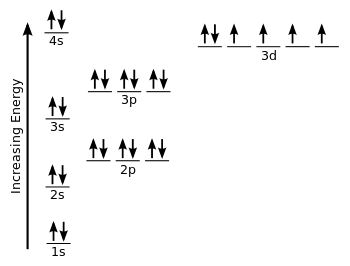
The electron configuration of iron (Fe) describes how its 26 electrons are arranged in different energy levels and atomic orbitals. Understanding the electronic configuration of iron helps explain its chemical properties, oxidation states, bonding behavior, and magnetic characteristics. The ground-state electron configuration of iron is 1s² 2s² 2p⁶ 3s² 3p⁶ 3d⁶ 4s², which can also be written in the noble gas shorthand notation as [Ar] 3d⁶ 4s². This electron arrangement is commonly used to study the orbital diagram of iron, valence electrons, electron filling order, and the periodic trends of transition metals.
Electron Configuration For Iron
-
Element Symbol: Fe
-
Atomic Number: 26
-
Full Configuration:
1s² 2s² 2p⁶ 3s² 3p⁶ 3d⁶ 4s² -
Shorthand Configuration:
[Ar] 3d⁶ 4s² -
Valence Electrons: 2 (from 4s²)
-
Partially Filled Subshell: 3d⁶ (important for magnetism)
-
Common Oxidation States: +2, +3
Iron Number of Valence Electrons
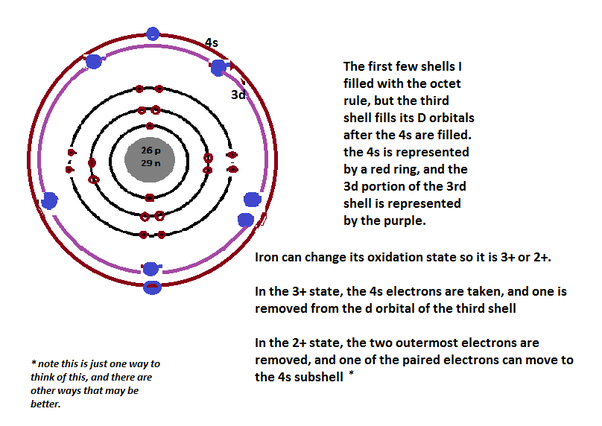
There are 2 electrons located in the outermost shell of iron which means iron has only 2 valence electrons.
Full Electron Configuration For Iron
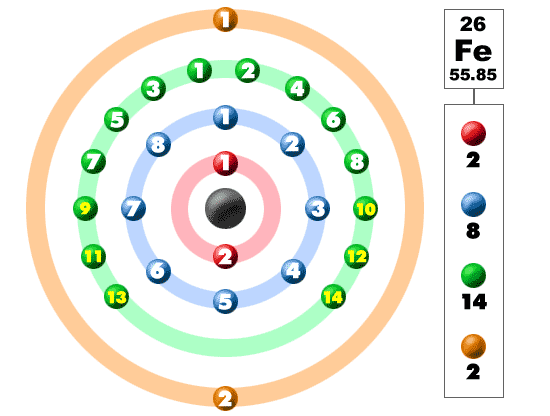
There are 26 electrons of iron whose distribution of atom is 2, 8, 14, and 2 in its four orbits. And electron configuration can be represented as 1s22s22p63s23p63d64s2 or in terms of Argon it can also be represented as [Ar] 3d64s2.
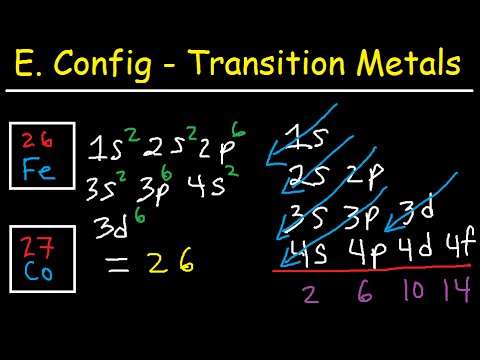
Iron the most common element on earth has 26 electrons and e configuration of iron it can be defined as [Ar] 3d64s2 and it can also be defined as 1s22s22p63s23p63d64s2
How Many Valence Electrons Does Iron have
The number of valence electrons depends upon the number of electrons located in the outermost shell of an atom and in case of iron there are only 2 electrons present in the 4th or outermost shell. So, there are 2 valence electrons in iron.
Frequently Asked Questions
Q1. What is the electron configuration of Iron (Fe)?
A: The electron configuration of Iron (Fe) is 1s² 2s² 2p⁶ 3s² 3p⁶ 3d⁶ 4s², or [Ar] 3d⁶ 4s² in noble gas notation. This arrangement shows how the 26 electrons of an iron atom are distributed among its atomic orbitals.
Q2. Why is the symbol of Iron “Fe” instead of “I”?
A: The chemical symbol Fe comes from the Latin word Ferrum, which was the ancient name for iron. This is why the symbol does not match the English spelling of the element.
Q3. How many valence electrons does Iron have?
A: Iron has 8 valence electrons when considering both the 4s and 3d orbitals, which contribute to its chemical bonding. This electron arrangement allows iron to exhibit multiple oxidation states, most commonly +2 and +3.
Q4. Why is the electron configuration of Iron important?
A: The electron configuration of iron helps explain its chemical reactivity, magnetic properties, bonding behavior, and oxidation states. It is an essential concept for understanding transition metals in chemistry and is frequently asked in school exams and competitive entrance tests.
Understanding the electron configuration of Iron (Fe) is essential for learning how this important transition metal behaves in chemical reactions. With an atomic number of 26, iron has the electron configuration [Ar] 3d⁶ 4s², which explains its unique physical and chemical properties, including its magnetic behavior and common oxidation states. Whether you’re preparing for chemistry exams, competitive tests, or simply expanding your knowledge of the periodic table, mastering the electronic configuration of iron provides a strong foundation for understanding atomic structure, electron arrangements, and the behavior of transition elements.
Leave a Reply