Understanding Cobalt valence electrons is essential for learning how this transition metal forms chemical bonds and reacts with other elements. In this guide, you’ll discover the electron configuration of cobalt, its Lewis dot structure, valency, and key properties. Cobalt (Co) is a valuable chemical element with atomic number 27 and plays a vital role in chemistry, electronics, batteries, and industrial applications.
- Flerovium Valence Electrons
- Plutonium Valence Electrons
- Mercury Valence electrons
- Neptunium Valence Electrons
- Moscovium Valence Electrons
- Cesium valence electrons
- Bismuth Valence electrons
- Silicon Valence Electrons
- Livermorium Valence Electrons
- Radon Valence electrons
- Xenon Valence Electrons
- Tennessine Valence Electrons
- Antimony Valence Electrons
- Radium Valence Electrons
- Oganesson Valence Electrons
- Lead Valence electrons
- Tellurium Valence Electrons
- Gold Valence Electrons
- Nobelium Valence Electrons
- Hydrogen Valence Electrons
- Phosphorus Valence Electrons
- Helium Valence Electrons
- Lithium Valence Electrons
- Americium Valence Electrons
- Beryllium Valence Electrons
- Boron Valence Electrons
- Sodium Valence Electrons
- Carbon Valence Electrons
- Nitrogen Valence Electrons
- Aluminum Valence Electrons
- Oxygen Valence Electrons
- Iodine Valence Electrons
- Fluorine Valence Electrons
- Magnesium Valence Electrons
- Neon Valence Electrons
- Sulfur Valence Electrons
How many valence electrons does Cobalt have?
Cobalt is a hard, lustrous, silvery-gray transition metal naturally found in the Earth’s crust, usually combined with nickel, copper, and other minerals. It was first isolated by Swedish chemist Georg Brandt in 1735, making it one of the earliest metals identified as a unique element. Thanks to its excellent heat resistance, magnetic properties, and corrosion resistance, cobalt is widely used across aerospace, automotive, medical, and manufacturing industries.
In the present time, Cobalt has emerged as a highly valuable chemical element. It has wide industrial usage in the production houses.
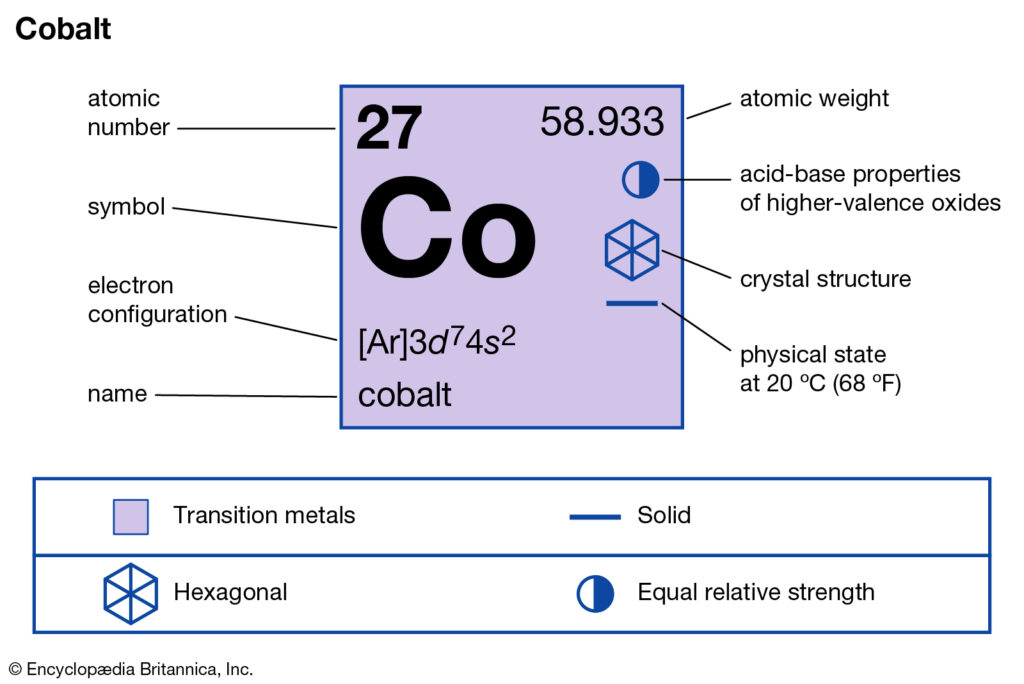
Cobalt has become one of the world’s most important industrial metals due to its extensive applications. It is a key component in lithium-ion batteries used in electric vehicles (EVs), smartphones, laptops, and renewable energy storage systems. Cobalt is also used to manufacture superalloys for aircraft engines, gas turbines, magnets, cutting tools, pigments, rechargeable batteries, and medical implants because of its exceptional strength and durability.
Cobalt Valence Electron Dot Diagram
The Lewis dot structure of cobalt illustrates the valence electrons surrounding the chemical symbol (Co). Lewis dot diagrams help explain how atoms form chemical bonds by representing the outermost electrons involved in bonding.
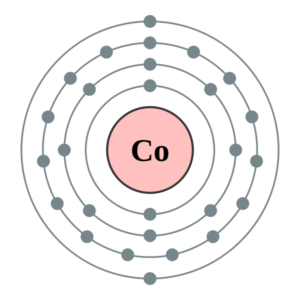
Although transition metals have more complex electron arrangements than main-group elements, the Lewis structure provides a simple visual representation of cobalt’s bonding behavior and chemical interactions.
Valency of Cobalt
The electron configuration of cobalt is [Ar] 3d⁷ 4s² (shell configuration: 2, 8, 15, 2), meaning cobalt has 2 electrons in its outermost energy level (4s shell). However, because cobalt is a transition metal, both the 4s and 3d electrons can participate in chemical bonding. As a result, cobalt commonly exhibits +2 and +3 oxidation states, while its traditional valency is often considered 2 or 3, depending on the compound it forms. This variable valency is one of the defining characteristics of transition elements.
Leave a Reply