Understanding potassium valence electrons is the key to learning how this highly reactive alkali metal forms chemical bonds and compounds. In this guide, you’ll discover the number of valence electrons in potassium, its electron configuration, Lewis dot structure, valency, and chemical properties in a simple and easy-to-understand way. Whether you’re a student preparing for exams or simply curious about chemistry, this article covers everything you need to know.
- Flerovium Valence Electrons
- Helium Valence Electrons
- Plutonium Valence Electrons
- Lithium Valence Electrons
- Mercury Valence electrons
- Americium Valence Electrons
- Neptunium Valence Electrons
- Oxygen Valence Electrons
- Moscovium Valence Electrons
- Sodium Valence Electrons
- Cesium valence electrons
- Magnesium Valence Electrons
- Bismuth Valence electrons
- Aluminum Valence Electrons
- Silicon Valence Electrons
- Beryllium Valence Electrons
- Livermorium Valence Electrons
- Fluorine Valence Electrons
- Radon Valence electrons
- Carbon Valence Electrons
- Xenon Valence Electrons
- Neon Valence Electrons
- Tennessine Valence Electrons
- Antimony Valence Electrons
- Radium Valence Electrons
- Oganesson Valence Electrons
- Iodine Valence Electrons
- Lead Valence electrons
- Sulfur Valence Electrons
- Tellurium Valence Electrons
- Boron Valence Electrons
- Gold Valence Electrons
- Nobelium Valence Electrons
- Neon Valence Electrons
- Hydrogen Valence Electrons
- Nitrogen Valence Electrons
- Phosphorus Valence Electrons
How many Valence Electrons does Potassium have
Potassium is a chemical element with its atomic number 19 in chemistry. The chemical element has the symbol of K in the periodic table. In general composition, potassium looks like soft silvery metal. The chemical reacts very rapidly in the exposure of oxygen within the atmosphere.
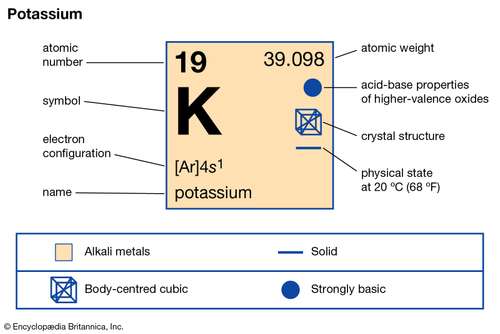
Potassium belongs to the alkali metal family and is naturally found in minerals and ionic salts rather than in its pure metallic form because it reacts quickly with air and water. It is the seventh most abundant element in Earth’s crust and is also an essential mineral for plants, animals, and humans. Potassium plays a vital role in nerve function, muscle contraction, fluid balance, and overall cellular health.
Furthermore, Potassium is also used across industrial products. There are many industries to produce potassium for commercial purposes.
Potassium Valence Electrons Dot Diagram
One of the easiest ways to understand the potassium valence electron is through its Lewis dot structure. A Lewis dot diagram represents the valence electrons surrounding an atom using dots placed around its chemical symbol. Since potassium has only one valence electron, its Lewis symbol is simply K•, making it easy to predict how the element forms chemical bonds.
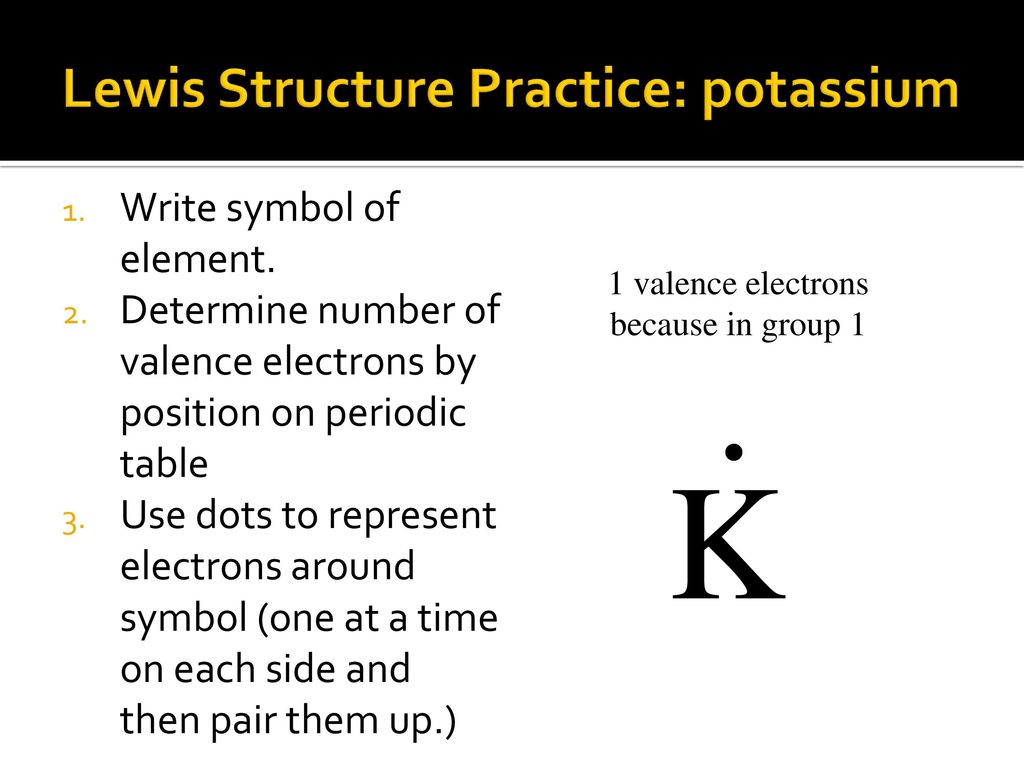
The Lewis dot structure helps explain whether valence electrons participate in chemical bonding or remain as lone pairs. For potassium, the single outermost electron is readily lost during chemical reactions to achieve a stable electron arrangement similar to the noble gas argon. As a result, potassium commonly forms the K⁺ ion and participates in ionic bonding with nonmetals such as chlorine, fluorine, and oxygen.
You can here explore the lewis dot diagram of potassium. The diagram will assist in the better valence electron analysis of Potassium.
Valency of Potassium
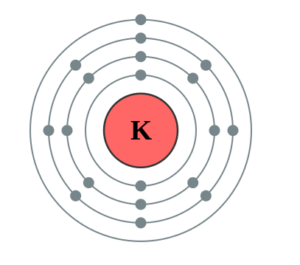
Potassium has an electron configuration of 1s² 2s² 2p⁶ 3s² 3p⁶ 4s¹, or 2, 8, 8, 1 in shell notation. The presence of one electron in the outermost 4s orbital confirms that potassium has one valence electron. This outer electron determines its chemical behavior, high reactivity, and position in Group 1 of the periodic table.
Because potassium contains one valence electron, its valency is 1 and its most common oxidation state is +1. Instead of gaining electrons, potassium almost always loses its single valence electron to form a stable K⁺ ion. This property makes potassium highly reactive and widely used in fertilizers, industrial chemicals, pharmaceuticals, glass manufacturing, and numerous biological processes.