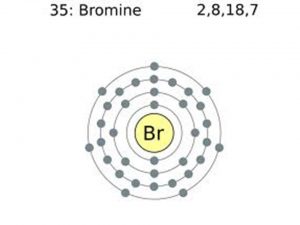
Bromine Electron Configuration explains how the 35 electrons of a bromine atom are arranged in different energy levels and orbitals. Bromine (Br) has an atomic number of 35 and belongs to the halogen group (Group 17) of the periodic table. It is a reddish-brown liquid at room temperature that easily evaporates to form a reddish vapor with a strong odor.
If you’re studying chemistry or preparing for exams, understanding the electron configuration of bromine, orbital diagram, and valence electrons is essential. This guide includes easy explanations, diagrams, and quick facts.
- Potassium Valency
- Calcium Valency
- Technetium Valency
- Titanium Valency
- Vanadium Valency
- Chromium Valency
- Manganese Valency
- iron Valency
- Cobalt Valency
- Nickel Valency
- Copper Valency
Bromine Electron Configuration
Quick Facts About Bromine (Br)
|
Property |
Value |
|
Element Name |
Bromine |
|
Symbol |
Br |
|
Atomic Number |
35 |
|
Atomic Mass |
79.904 u |
|
Group |
17 (Halogens) |
|
Period |
4 |
|
Block |
p-block |
|
Number of Electrons |
35 |
|
Number of Protons |
35 |
|
Number of Neutrons |
45 (most common isotope) |
| Valence Electrons |
7 |
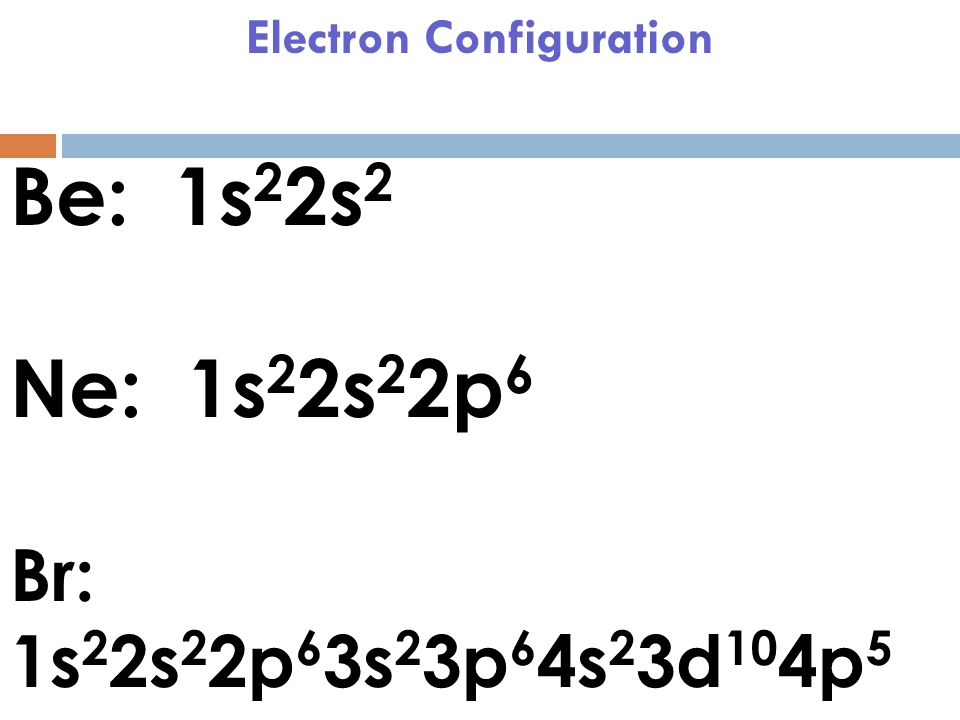
The properties of chlorine are intermediate between those of iodine and chlorine. Bromine Orbital Diagram. In this article today we are going to tell you about the electron configuration of Bromine, its orbital diagram, and valence electron. Also, we will provide the pictures of the same. Please read the full article below for more information.
- Titanium Valence Electrons
- Vanadium Valence Electrons
- Chromium Valence Electrons
- Carbon Electron Configuration
- Oxygen Electron Configuration
- Manganese Valence Electrons
- Helium Electron Configuration
- Beryllium Electron Configuration
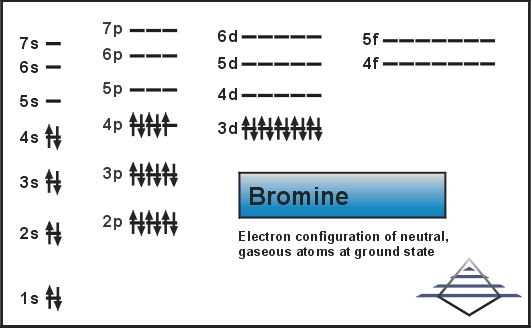
Bromine Orbital Diagram

The Bromine orbital diagram shows how all 35 electrons are arranged in atomic orbitals according to the Aufbau Principle, Hund’s Rule, and the Pauli Exclusion Principle. Since bromine has an atomic number of 35, its electrons fill orbitals in this order:
1s → 2s → 2p → 3s → 3p → 4s → 3d → 4p
Electrons always occupy the lowest-energy orbitals first before moving to higher energy levels. After the 4s orbital is filled, the 3d orbitals are completed, followed by the 4p orbitals. According to Hund’s Rule, electrons fill each 4p orbital singly before pairing, resulting in bromine’s final 4p⁵ electron arrangement. Understanding the Bromine orbital filling diagram makes it easier to visualize its electron configuration, 7 valence electrons, and chemical behavior.
Bromine Ground-State Electron Configuration
The complete electron configuration of the Bromine is: 1s2 2s2 2p6 3s2 3p6 3d10 4s2 4p5. You can also see the image given below;
Bromine Valence Electrons
Bromine has 7 valence electrons.
These electrons are located in the outermost energy level:
- 4s²
- 4p⁵
Total:
2 + 5 = 7 Valence Electrons
Because bromine needs only one more electron to complete its octet, it is highly reactive and commonly forms a -1 ion (Br⁻).
See the picture below;