Molybdenum Electron Configuration: Understanding the Molybdenum electron configuration is one of the easiest ways to learn how this transition metal behaves during chemical reactions. Whether you’re a chemistry student, preparing for competitive exams, or simply exploring the periodic table, knowing the electron arrangement of Molybdenum (Mo) helps explain its oxidation states, bonding behavior, and unique chemical properties. In this guide, you’ll learn the complete electron configuration, orbital diagram, electron shell distribution, and valence electrons of Molybdenum in a simple and easy-to-understand format.
- Bromine Electron Configuration
- Sodium Electron Configuration
- Magnesium Electron Configuration
- Aluminum Electron Configuration
- Silicon Electron Configuration
- Sulfur Electron Configuration
- Chlorine Electron Configuration
- Phosphorus Electron Configuration
- Argon Electron Configuration
- Potassium Electron Configuration
- Scandium Electron Configuration
Molybdenum Electron Configuration
Molybdenum (Mo) is a transition metal with atomic number 42 and belongs to Group 6 of the periodic table. It is naturally found in minerals such as molybdenite (MoS₂) rather than in its pure elemental form. Due to its exceptional strength, high melting point, corrosion resistance, and excellent conductivity, Molybdenum is widely used in steel alloys, aerospace components, electrical equipment, catalysts, and industrial machinery.
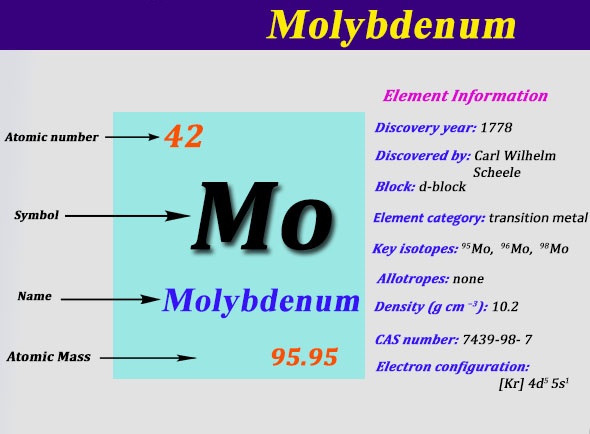
The electron configuration of Molybdenum describes how its 42 electrons are distributed among different energy levels, subshells, and atomic orbitals. This arrangement allows scientists to predict the element’s chemical reactivity, oxidation states, magnetic properties, atomic bonding, and position in the periodic table. Learning the orbital filling pattern also makes it easier to understand why Molybdenum exhibits unique chemical behavior compared to many other transition metals.
Electron Configuration of Molybdenum?
The Electron Configuration of the Molybdenum can be represented as Molybdenum is having the 42 as its atomic number and is located in the group 6 period 5 of the periodic table.
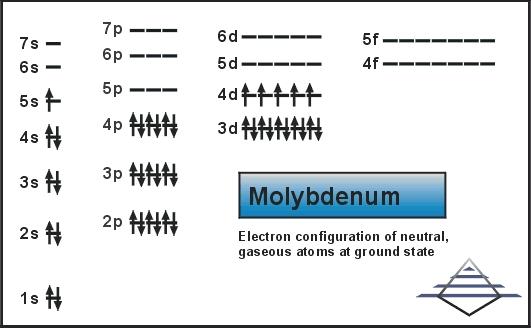
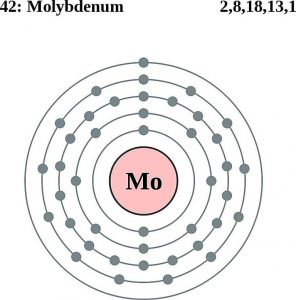
This electron configuration of Mo is in the condensed form and on the ground state. Molybdenum further holds 42 electrons in its shell structure of 2.8.18.13.1
How Many Valence Electrons Does Molybdenum Have?
One of the most interesting facts about Molybdenum is its exceptional electron configuration. Instead of following the expected electron arrangement, it adopts the more stable configuration [Kr] 4d⁵ 5s¹. This half-filled 4d subshell provides extra stability and explains why Molybdenum commonly shows oxidation states of +2, +3, +4, +5, and +6, with +6 being the most common. This unique electron arrangement is the key reason for its widespread use in advanced engineering, metallurgy, and modern industrial applications.
Molybdenum Number of Valence Electrons
As we have explained above that the Molybdenum is having the Valence of 0,2+,3+,4+,5+ and 6+.
The simple explanation behind this Valence of Molybdenum is the capability of this chemical element. It can use the one Electron in the 5s shell and then it further can use the 5 electrons in the 4d shell due to its extreme flexibility which is unique in its kind.
Leave a Reply