Zinc Electron Configuration: Zinc (Zn) is an essential chemical element with the chemical symbol Zn and atomic number 30. It belongs to Group 12 of the periodic table and is widely recognized for its excellent corrosion resistance, galvanizing properties, and extensive industrial applications. Zinc commonly exists in the +2 oxidation state, making it chemically similar to magnesium (Mg) under certain conditions. Because Zn²⁺ and Mg²⁺ ions have nearly identical ionic sizes, they often display comparable chemical behavior in various compounds and biological systems. Zinc is also an essential trace mineral required for human health, supporting immunity, enzyme function, wound healing, DNA synthesis, and normal growth.
Zinc Electron Configuration
Zinc is the 24th most abundant element in the Earth’s crust and naturally occurs in several mineral deposits around the world. It has five stable isotopes, contributing to its stability and broad scientific applications. The most important commercial zinc ore is sphalerite (zinc blende), a naturally occurring zinc sulfide (ZnS) mineral that serves as the primary source for global zinc production. Today, zinc is widely used in galvanized steel, batteries, metal alloys, die casting, construction materials, automotive manufacturing, electronics, dietary supplements, and numerous other industrial and commercial applications, making it one of the world’s most valuable and versatile metals.
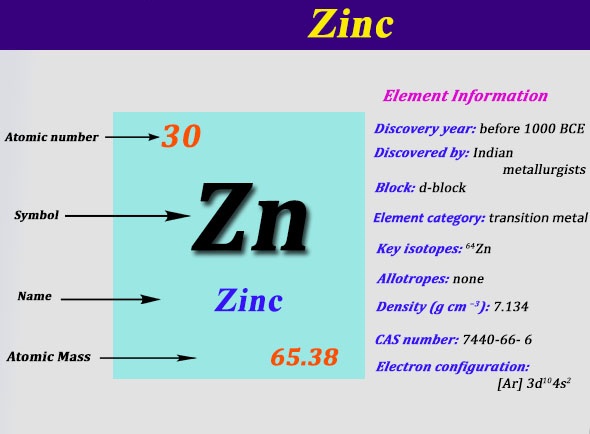
The largest working lodes of Zinc are in Asia, Australia, and the United States. It is refined by roasting, froth flotation of the ore, and final extraction using electricity or electrowinning. Today we are going to tell you the electron configuration of the Zn.
What is the Electron Configuration of Zinc
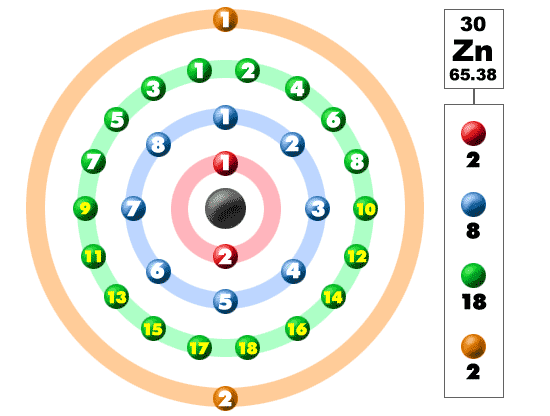
[Ar] 3d10 4s2 is the electron configuration of Zinc.
How Many Valence Electrons does Zinc Have
Zinc has two valence electrons in its outer shell.
- Chlorine Valency
- Argon Valency
- Potassium Valency
- Calcium Valency
- Technetium Valency
- Titanium Valency
- Vanadium Valency
- Chromium Valency
- Manganese Valency
- iron Valency
- Cobalt Valency
- Nickel Valency
- Copper Valency
- Zinc Valency
- Gallium Valency
- Germanium Valency
- Arsenic Valency
- Selenium Valency
Zinc Number of Valence Electrons
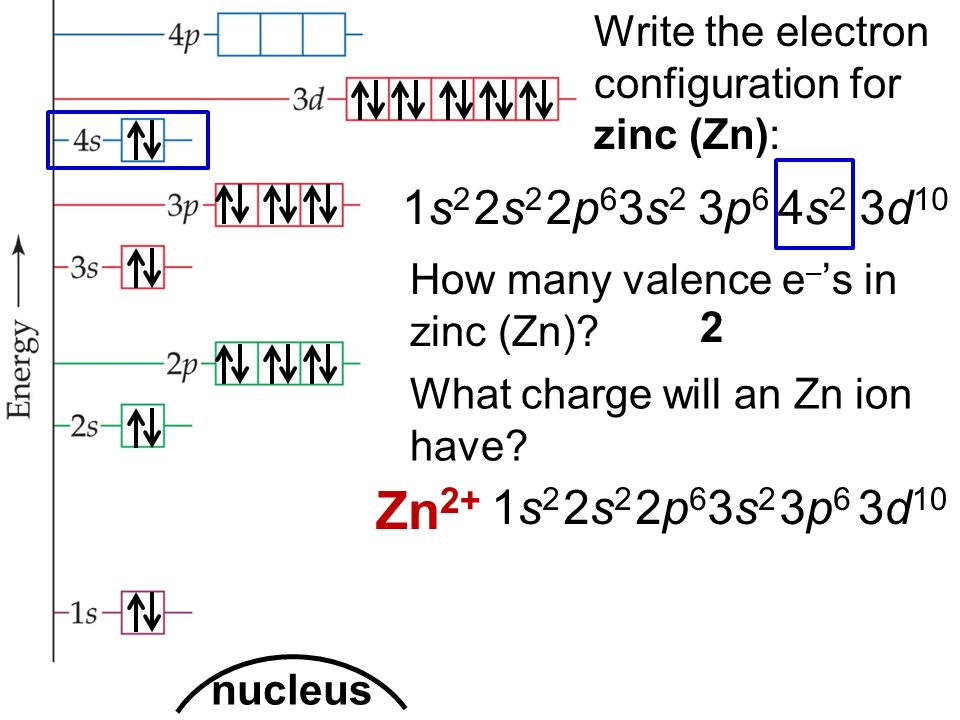
Zinc (Zn) has 2 valence electrons. Its atomic number is 30, and its electron configuration is [Ar] 3d¹⁰ 4s². The two electrons in the outermost 4s orbital are considered the valence electrons.
When zinc forms compounds, it typically loses these two 4s electrons to produce the Zn²⁺ ion, resulting in its most common oxidation state of +2. The filled 3d¹⁰ subshell remains stable, which is why zinc almost exclusively exhibits a +2 oxidation state in chemical reactions.
There are two valence electrons in the outer shell of the Zinc.
Frequently Asked Questions
Q1. What is the electron configuration of zinc (Zn)?
A: The electron configuration of zinc is [Ar] 3d¹⁰ 4s². In full notation, it is 1s² 2s² 2p⁶ 3s² 3p⁶ 3d¹⁰ 4s².
Q2. How many valence electrons does zinc have?
A: Zinc has 2 valence electrons, located in the 4s orbital. These electrons are typically lost when zinc forms compounds.
Q3. Why is the 4s orbital filled before the 3d orbital?
A: According to the Aufbau principle, the 4s orbital has a slightly lower energy than the 3d orbitals in neutral atoms, so it fills first. After electron removal, however, the 4s electrons are lost before the 3d electrons.
Q4. What ion does zinc usually form?
A: Zinc most commonly forms the Zn²⁺ ion by losing its two 4s electrons. This leaves a stable 3d¹⁰ electron configuration, making the +2 oxidation state the most common.
Conclusion
Understanding the zinc electron configuration (Zn) is essential for learning its chemical properties, bonding behavior, and oxidation states. With the electron configuration [Ar] 3d¹⁰ 4s², zinc possesses 2 valence electrons and commonly forms the stable Zn²⁺ ion. Its fully filled 3d subshell contributes to its stability and explains why zinc is widely used in galvanization, batteries, metal alloys, electronics, and biological processes. Mastering zinc’s orbital diagram and electron configuration provides a strong foundation for studying chemistry, the periodic table, and atomic structure.