Understanding manganese valence electrons is essential for learning how this transition metal forms chemical bonds and participates in various chemical reactions. In this guide, you’ll learn about the valence electrons of manganese (Mn), its Lewis dot structure, electron configuration, oxidation states, and other important atomic properties. Manganese is a transition metal with the chemical symbol Mn and atomic number 25, making it an important element in both chemistry and industry.
- Flerovium Valence Electrons
- Plutonium Valence Electrons
- Mercury Valence electrons
- Neptunium Valence Electrons
- Moscovium Valence Electrons
- Cesium valence electrons
- Bismuth Valence electrons
- Boron Valence Electrons
- Sodium Valence Electrons
- Carbon Valence Electrons
- Nitrogen Valence Electrons
- Aluminum Valence Electrons
- Oxygen Valence Electrons
- Iodine Valence Electrons
- Fluorine Valence Electrons
- Magnesium Valence Electrons
- Neon Valence Electrons
- Sulfur Valence Electrons
How many valence electrons does Manganese have?
Manganese is naturally found in the Earth’s crust but does not occur as a pure metal in nature because of its high reactivity. It is mainly extracted from manganese-rich minerals such as pyrolusite (MnO₂), rhodochrosite (MnCO₃), and manganite. As a member of the d-block transition metals in the periodic table, manganese has the electron configuration [Ar] 3d⁵ 4s² and 7 valence electrons (considering the outer 4s and available 3d electrons involved in bonding). It is widely studied for its unique electronic configuration and multiple oxidation states.
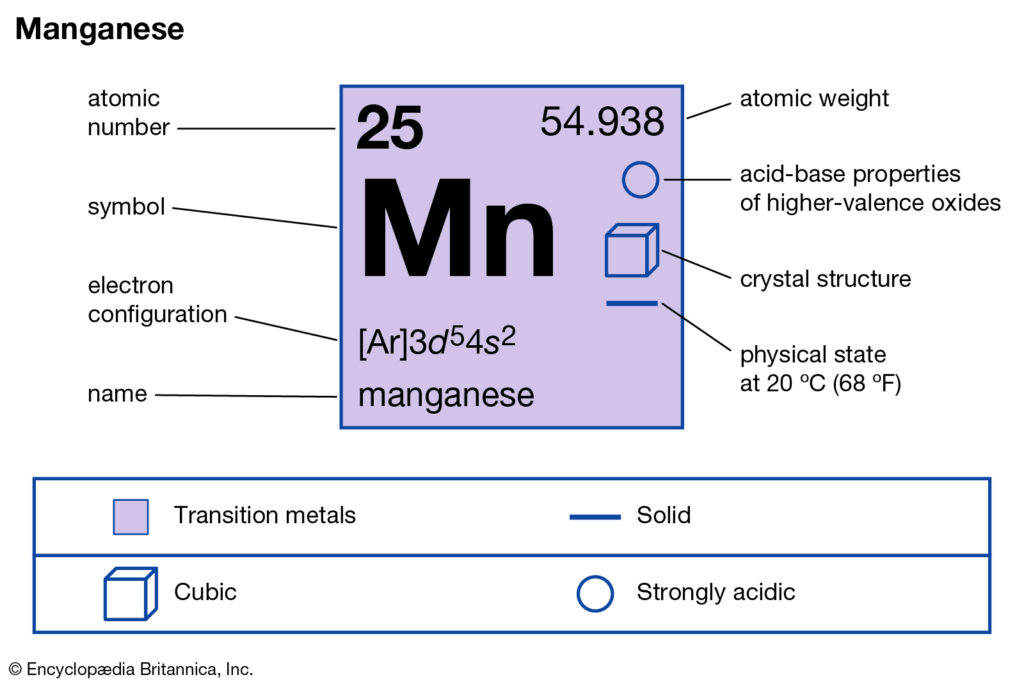
The properties of manganese make it indispensable across many industries. It is primarily used in the manufacturing of stainless steel, where it improves strength, hardness, and resistance to wear. Manganese is also an essential component in steel alloys, aluminum alloys, batteries, welding materials, fertilizers, pigments, and dry-cell batteries. Its ability to enhance durability and corrosion resistance makes manganese one of the most valuable industrial metals used in engineering and construction.
Manganese Valence Electron Dot Diagram
An electron dot diagram is an important tool in the proper analysis of valence electrons for the element. You can also explore an in-depth electron dot diagram of Manganese valence electrons.
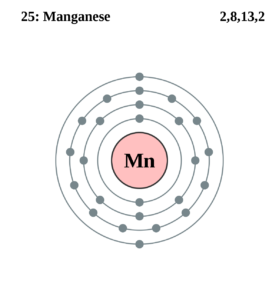
The Manganese Lewis dot structure (also called the Lewis electron dot diagram) is a simple representation of the element’s valence electrons. In this diagram, dots are placed around the Mn symbol to represent the electrons available for chemical bonding. The Lewis dot diagram helps students understand chemical bonding, electron distribution, valency, and molecular structure. Learning how to draw the manganese Lewis dot structure is an important step in mastering concepts such as valence electrons, electron configuration, periodic trends, and chemical reactions.
Valency of Manganese – Mn
Well, as we know that Manganese belongs to the category of transition chemical element. So, It may therefore have the variable valency at times. The most possible valency of Manganese is 2,4,7. Manganese has a decently stable electron configuration hence such valency.