Arsenic Electron Configuration: Arsenic (As) is a chemical element with atomic number 33 on the periodic table. It belongs to the metalloid group and is known for its unique physical and chemical properties. Arsenic naturally occurs in many arsenic minerals, often combined with sulfur, iron, copper, and other metals, while pure elemental arsenic forms brittle, crystalline solids. The element exists in several allotropes, with gray arsenic being the most stable and commonly found metallic form. Understanding the Arsenic orbital diagram, electron configuration, valence electrons, and Bohr model helps students learn how electrons are arranged and how arsenic behaves during chemical bonding.
- Hydrogen Electron Configuration
- Helium Electron Configuration
- Lithium Electron Configuration
- Beryllium Electron Configuration
- Boron Electron Configuration
- Carbon Electron Configuration
- Nitrogen Electron Configuration
- Oxygen Electron Configuration
Arsenic Electron Configuration
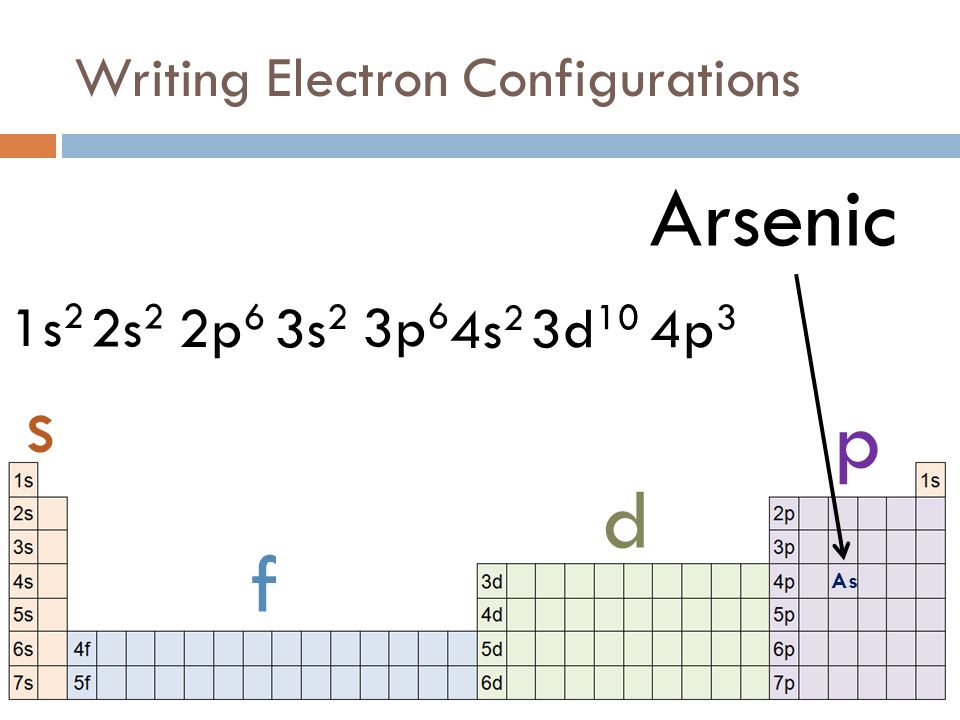
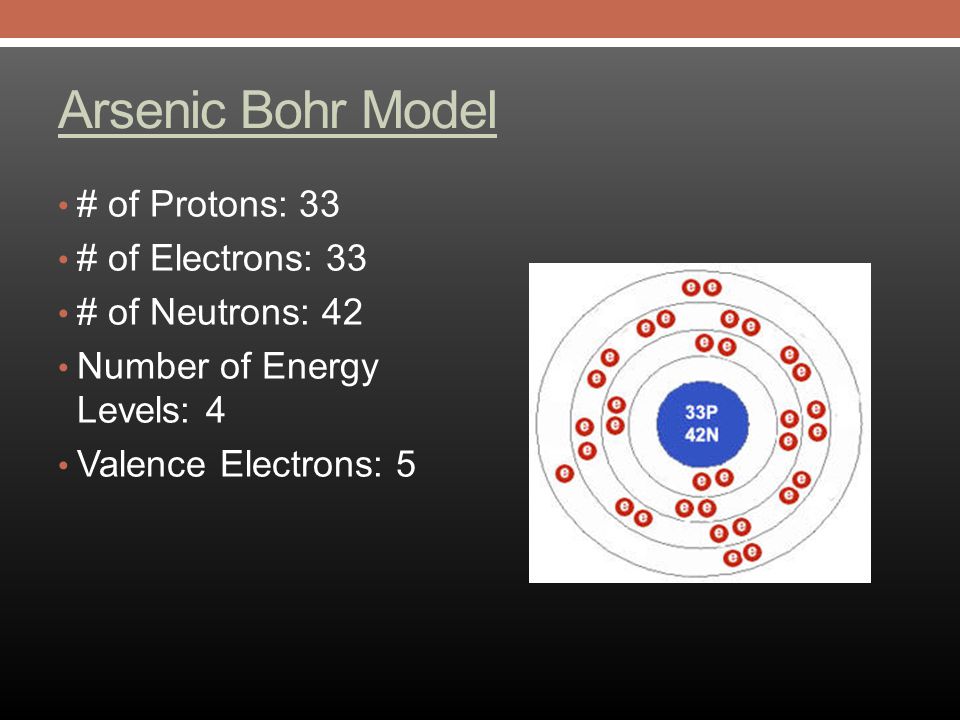
An electronic configuration is a number of electrons in the orbits of molecules and atoms. Well, in the case of Arsenic there are 33 electrons which lie in 4 shells. The distribution of electrons in shells is: 2, 8, 18, 5, and this electronic configuration can be written as:
1s22s22p63s23p64s23d104p3 or [Ar] 3d104s24p3
- Hydrogen Valence Electrons
- Helium Valence Electrons
- Lithium Valence Electrons
- Beryllium Valence Electrons
- Boron Valence Electrons
- Carbon Valence Electrons
- Nitrogen Valence Electrons
- Oxygen Valence Electrons
Arsenic Number of Valence Electrons
Valence electrons are the number of electrons that are present at the outermost shell of the atom or molecules. In the case of Arsenic, there are 5 electrons in the outer or fourth shell.
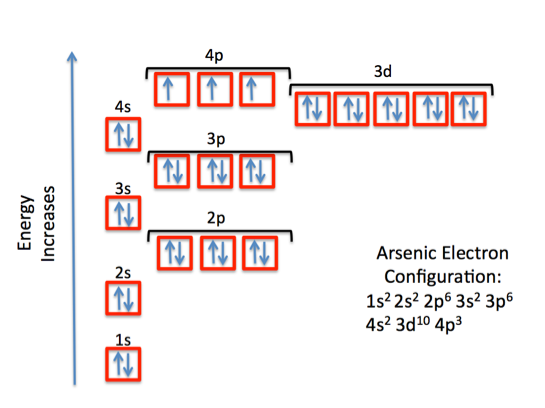
Ground State Electron Configuration For Arsenic
The ground-state electron configuration of an atom can represent in the form of pairs of electrons which can also be represented in the orbital diagram as well. And this ground-state electron configuration for Arsenic is defined as:
1s22s22p63s23p64s23d104p3
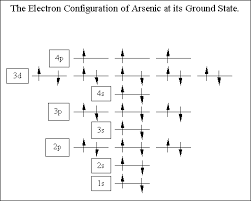
What is The Electron Configuration of Arsenic
The electron configuration of arsenic (As) shows how its 33 electrons are arranged in different energy levels and orbitals. Since arsenic has an atomic number of 33, its electron configuration is:
1s² 2s² 2p⁶ 3s² 3p⁶ 4s² 3d¹⁰ 4p³
This electron arrangement explains arsenic’s valence electrons, chemical bonding, oxidation states, and reactivity, making it an important concept in chemistry and the periodic table.

How Many Valence Electrons Are in Arsenic
Valence electrons are the electrons which are present in the outer shell or orbit. And there are 5 valence electrons in Arsenic.
What is The Orbital Diagram For Arsenic
The Arsenic orbital diagram illustrates the arrangement of all 33 electrons in atomic orbitals using arrows (↑↓), where each arrow represents an electron and opposite arrows indicate paired electrons. Following the Aufbau principle, Hund’s rule, and the Pauli exclusion principle, arsenic has the electron configuration 1s² 2s² 2p⁶ 3s² 3p⁶ 3d¹⁰ 4s² 4p³. The final 4p³ subshell contains three unpaired electrons, while the remaining 30 electrons are paired in their respective orbitals. This orbital diagram is essential for understanding arsenic’s electron arrangement, oxidation states, chemical reactivity, and bonding behavior.