Sodium Valence Electrons: Sodium (Na) is a highly reactive alkali metal with the chemical symbol Na, derived from the Latin word Natrium. It has an atomic number of 11 and belongs to Group 1 and Period 3 of the modern periodic table. Sodium is a soft, silver-white metal that can be easily cut with a knife because of its low hardness. It is the sixth most abundant element in the Earth’s crust and plays an essential role in chemistry, biology, and various industrial applications. Due to its high reactivity, sodium is never found in its pure form in nature.
- Flerovium Valence Electrons
- Moscovium Valence Electrons
- Livermorium Valence Electrons
- Tennessine Valence Electrons
- Oganesson Valence Electrons
- Nobelium Valence Electrons
- Neptunium Valence Electrons
- Plutonium Valence Electrons
- Americium Valence Electrons
- Gold Valence electrons
- Mercury Valence electrons
- Lead Valence electrons
- Bismuth Valence electrons
- Radon Valence electrons
- Radium Valence Electrons
- Antimony Valence Electrons
- Tellurium Valence Electrons
- Iodine Valence Electrons
- Xenon Valence Electrons
- Caesium valence electrons
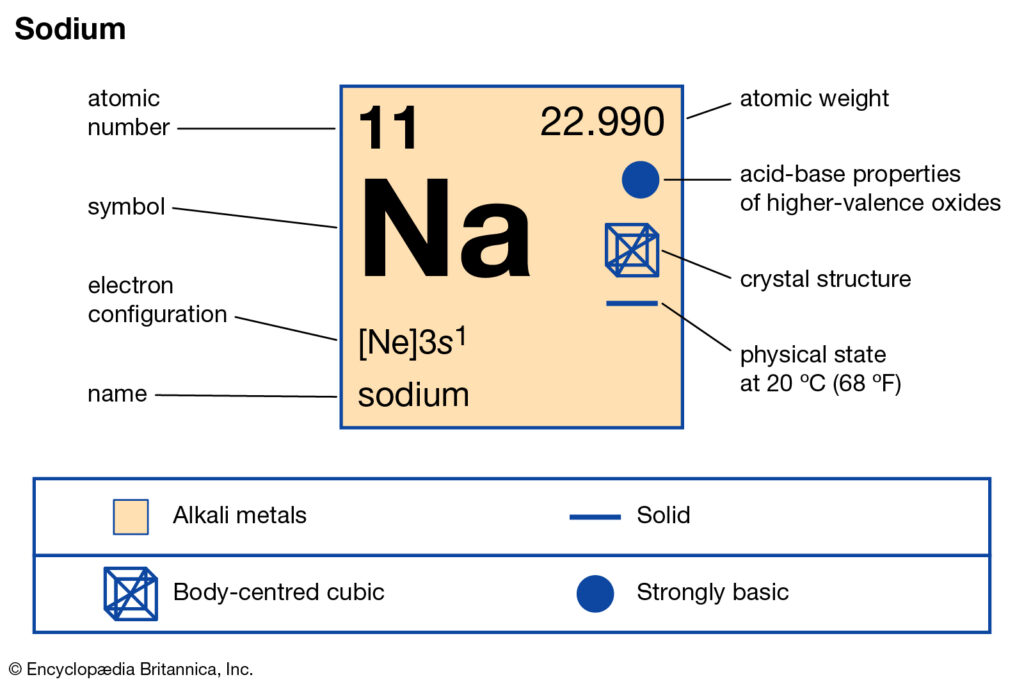
Sodium naturally occurs in several minerals, including rock salt (halite), feldspars, sodalite, and sodium-rich compounds. One of its most important compounds is sodium chloride (NaCl), commonly known as table salt, which is widely used in cooking, food preservation, and chemical manufacturing. Sodium forms many water-soluble salts and is an excellent conductor of heat and electricity. As an alkali metal, it readily loses one electron during chemical reactions, making it highly reactive with water, oxygen, and other non-metals.
Sodium Valence Electrons Dot Diagram
Lewis’s electron dot diagram is also known as the valence electrons dot diagram. The diagram shows the valence electrons of the atom which is located as a dot as a circle form around the element. What is the number of dots known here? The number of dots in the diagram is known as the number of valence electrons in the atom. These dots are located around the symbol of the element in the right, left, above and below of the symbol. Here, is the dot diagram of sodium valence electrons for you. From which you can easily clear out your concept of the particular chemical elements. So, you can check out any of the chemical element’s diagram from here itself.
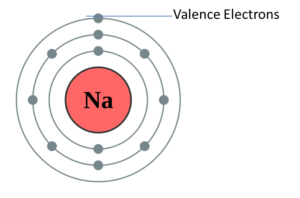
Valency of Sodium – Na
The electronic configuration of sodium is 2, 8, 1, which means it has 11 electrons arranged across three electron shells. The first shell contains 2 electrons, the second shell contains 8 electrons, and the third (outermost) shell contains 1 electron. This single outer electron is called the valence electron, which determines the valency of sodium. Since sodium loses this one electron to achieve a stable noble gas configuration, its valency is 1. Understanding the valence electrons of sodium, electron distribution, and electronic configuration is important for learning chemical bonding, ionic compounds, and the periodic table.