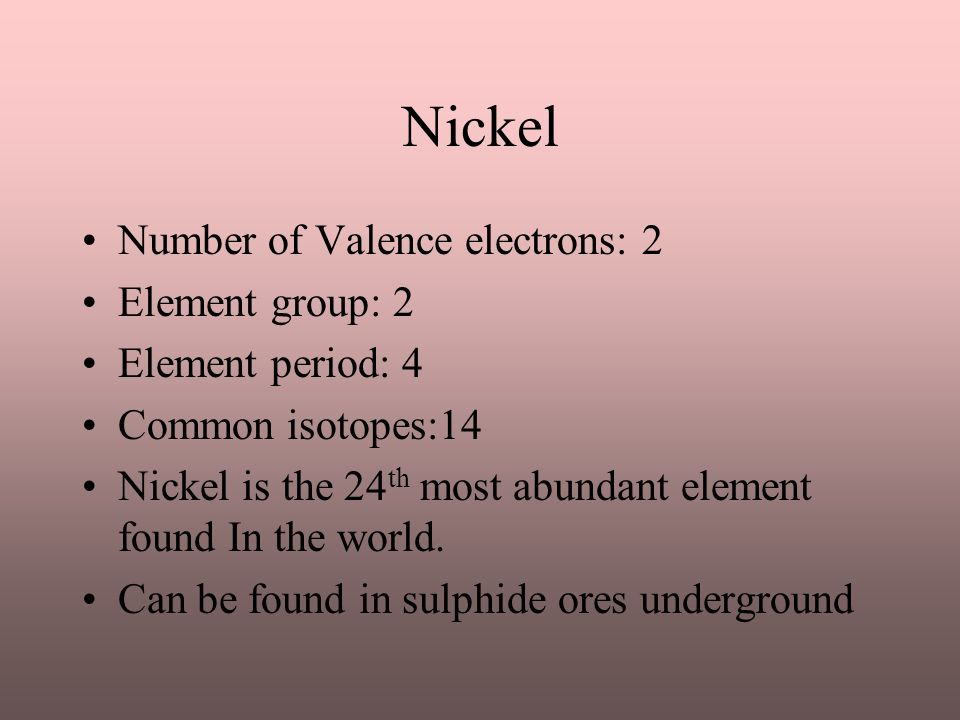
Nickel Electron Configuration is one of the most searched topics in chemistry because it explains how the 28 electrons of a nickel atom are arranged in different energy levels and orbitals. Nickel (Ni) is a transition metal with atomic number 28 and is located in Group 10, Period 4 of the periodic table. It is a hard, ductile, silvery-white metal with a slight golden tint that offers excellent corrosion resistance, high strength, and magnetic properties. Due to these characteristics, nickel is widely used in stainless steel, rechargeable batteries, coins, electroplating, and industrial alloys.
Understanding the electron configuration of Nickel helps explain its chemical behavior, oxidation states, bonding, and magnetic properties. Since nickel has 28 electrons, they are distributed among four electron shells according to the Aufbau principle, Hund’s rule, and the Pauli exclusion principle. The electron configuration of Ni is [Ar] 3d⁸ 4s², while its full electron configuration is 1s² 2s² 2p⁶ 3s² 3p⁶ 3d⁸ 4s². Learning the Nickel electron configuration also makes it easier to understand its valency, orbital diagram, shell distribution, and role in various chemical reactions.
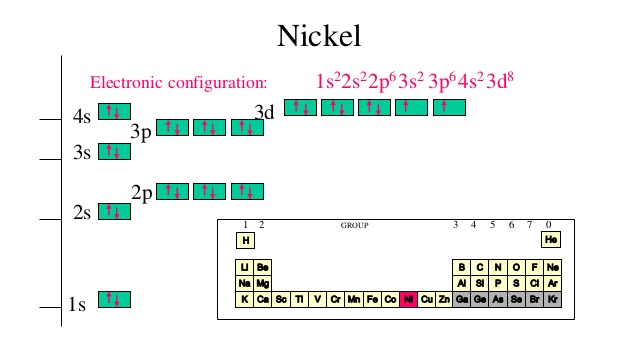
Electronic configuration of nickel can be written as: 1s22s22p63s23p63d84s2 or it can also be written as [Ar] 3d84s2
What is The Electron Configuration of Nickel
The electron configuration of Nickel (Ni) describes how its 28 electrons are arranged in different energy levels and atomic orbitals. Nickel has an atomic number of 28, meaning a neutral nickel atom contains 28 electrons. These electrons are distributed across four electron shells according to the Aufbau principle, Hund’s rule, and the Pauli exclusion principle.
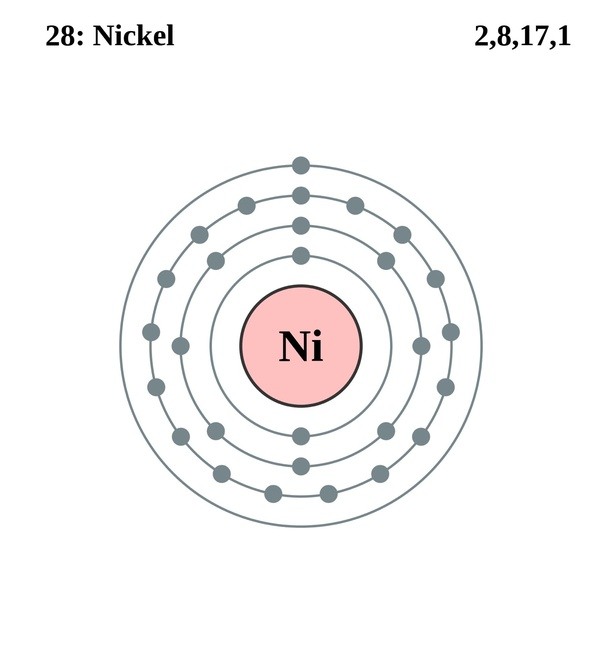
The electron configuration of Nickel is [Ar] 3d⁸ 4s², while its complete electron configuration is 1s² 2s² 2p⁶ 3s² 3p⁶ 3d⁸ 4s². This electron arrangement determines nickel’s chemical properties, oxidation states, magnetic behavior, bonding characteristics, and reactivity. Understanding the electron configuration of nickel is essential for studying its role in chemistry, metallurgy, and industrial applications.
- Chlorine Valence Electrons
- Argon Valence Electrons
- Potassium Valence Electrons
- Calcium Valence Electrons
- Technetium Valence Electrons
- Titanium Valence Electrons
- Vanadium Valence Electrons
- Chromium Valence Electrons
- Manganese Valence Electrons
- iron Valence Electrons
- Cobalt Valence Electrons
- Nickel Valence Electrons
- Copper Valence Electrons
- Zinc Valence Electrons
- Gallium Valence Electrons
How Many Valence Electrons Does Nickel Have
Nickel (Ni) has 2 valence electrons because its outermost (4th) energy level contains two electrons in the 4s orbital. Valence electrons are the electrons in the highest energy shell that participate in chemical bonding and determine an element’s reactivity. Since nickel has the electron configuration [Ar] 3d⁸ 4s², the two 4s electrons are generally considered its valence electrons. These electrons play a key role in nickel’s chemical properties, oxidation states, and its ability to form stable compounds. Understanding the valence electrons of Nickel is essential for studying its electron configuration, Lewis dot structure, bonding behavior, and position in the periodic table.
Nickel Number of Valence Electrons
Valence electrons are the electrons which are located in the outer shell or orbit. There are 28 electrons in the nickel in the 4 orbits and the number of electrons present in the outermost shell is 2. That is, nickel consists of 2 valence electrons.