Want to learn how to calculate electron mass and charge in a simple way? The mass of an electron, also known as the rest mass of an electron, is one of the most important fundamental constants in physics and chemistry. It plays a crucial role in understanding atomic structure, electric charge, subatomic particles, electromagnetic forces, quantum mechanics, and chemical reactions. Scientists use several experimental methods and mathematical formulas to determine the electron’s mass and charge with remarkable precision, making it a cornerstone of modern science.
The first successful attempts to determine the electron’s mass-to-charge ratio (e/m) were made in the late 19th century. In 1890, physicist Arthur Schuster estimated the ratio by observing how cathode rays were deflected in a magnetic field inside a cathode ray tube. A few years later, in 1897, J. J. Thomson proved that cathode rays were actually streams of negatively charged particles called electrons, revolutionizing atomic physics. His groundbreaking experiment laid the foundation for calculating the electron’s charge, electron mass, e/m ratio, charge-to-mass ratio, and many other concepts that remain essential in physics today.
How To Calculate Electron Mass and Charge?
The electron is a fundamental subatomic particle that plays a crucial role in the structure of atoms and the behavior of matter. To calculate the mass and charge of an electron, we need to refer to established scientific constants and formulas.
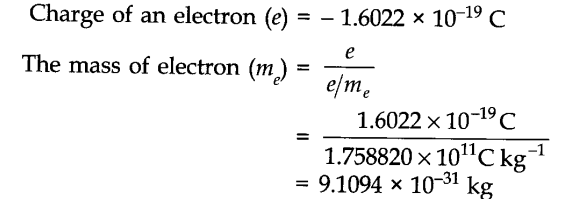
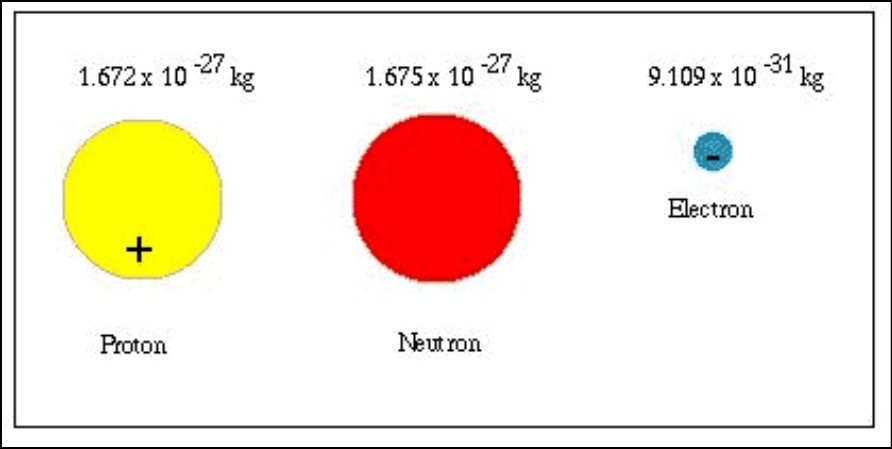
The mass of an electron is approximately 9.109 × 10⁻³¹ kilograms (kg), making it one of the lightest known subatomic particles. Because this value is incredibly small, scientists commonly express electron mass using the atomic mass unit (u or amu), a standard unit for comparing atomic and subatomic masses. One atomic mass unit is defined as 1/12 of the mass of a carbon-12 atom, which equals approximately 1.66054 × 10⁻²⁷ kilograms. Using this conversion, the electron has a mass of approximately 0.00054858 u (amu), a value widely used in chemistry, atomic physics, and quantum mechanics.
The charge of an electron is −1.602176634 × 10⁻¹⁹ coulombs (C), representing the fundamental unit of negative electric charge, also known as the elementary charge. Every electron carries exactly this amount of negative charge, while every proton carries an equal magnitude of positive charge. This balance of positive and negative charges is responsible for the formation of atoms, chemical bonding, electricity, magnetism, and countless physical phenomena observed in nature.
To calculate the mass and charge of an electron, scientists use the internationally accepted standard values below:
- Mass of an Electron: 9.109 × 10⁻³¹ kg (approximately 0.00054858 atomic mass units (amu)). This is the standard electron mass, widely used in physics, chemistry, atomic structure, quantum mechanics, and scientific calculations.
- Charge of an Electron: −1.602176634 × 10⁻¹⁹ coulombs (C). This is the elementary negative electric charge carried by every electron and is a fundamental constant used in electromagnetism, electricity, electronics, atomic physics, and chemical reactions.
Learn What are the Difference Between Charge and Electron here.
Electron Mass Number
The mass number of an electron is often misunderstood because electrons are not part of an atom’s nucleus. Unlike protons and neutrons, which are collectively called nucleons, electrons occupy the electron cloud or energy levels surrounding the nucleus. Since the mass number refers only to particles inside the nucleus, electrons have no mass number.
To understand this concept, remember that an atom’s mass number is calculated by adding the number of protons and number of neutrons in its nucleus. Although electrons do have a very small mass (about 1/1836 the mass of a proton), their mass is negligible compared to nucleons and they are not included in the mass number calculation. This is why the mass number of an electron is effectively zero in nuclear notation.
For example, consider a carbon-12 atom. The number 12 is its mass number, representing the total number of nucleons in the nucleus: 6 protons + 6 neutrons = 12. Carbon-12 also contains 6 electrons, but these electrons orbit outside the nucleus and do not affect the atom’s mass number. Regardless of the number of electrons gained or lost during ion formation, the mass number remains unchanged because only protons and neutrons are counted.
In summary, the mass number is a nuclear property that measures the total number of protons and neutrons in an atom’s nucleus. Electrons do not have a mass number because they are not nucleons and are located outside the nucleus. Understanding the difference between atomic number, mass number, electron mass, nucleons, and electron configuration helps avoid common misconceptions in chemistry and atomic physics.
Electron Charge to Mass Ratio
The electron charge-to-mass ratio is a fundamental constant that has played a significant role in the development of modern physics. It sdenoted by the symbol “e/m” and represents the ratio of the electron’s charge (e) to its mass (m).
The value of the charge-to-mass ratio of an electron was first measured by J.J. Thomson in 1897 using cathode ray tubes. He observed the deflection of electrons in the presence of electric and magnetic fields and determined that the charge-to-mass ratio of an electron is approximately 1.75882 x 10^11 coulombs per kilogram (C/kg).
This value is of great importance as it allows scientists to predict the behavior of electrons in various electromagnetic fields. It is crucial in understanding the principles of particle accelerators, mass spectrometry, and even in the development of cathode ray tube televisions.
Moreover, the electron charge-to-mass ratio played a vital role in the discovery of the electron’s actual charge and mass. By comparing this ratio with the known elementary charge (e) and the mass of an electron (m), physicists were able to determine both the charge and mass independently.
Proton Neutron Electron Mass
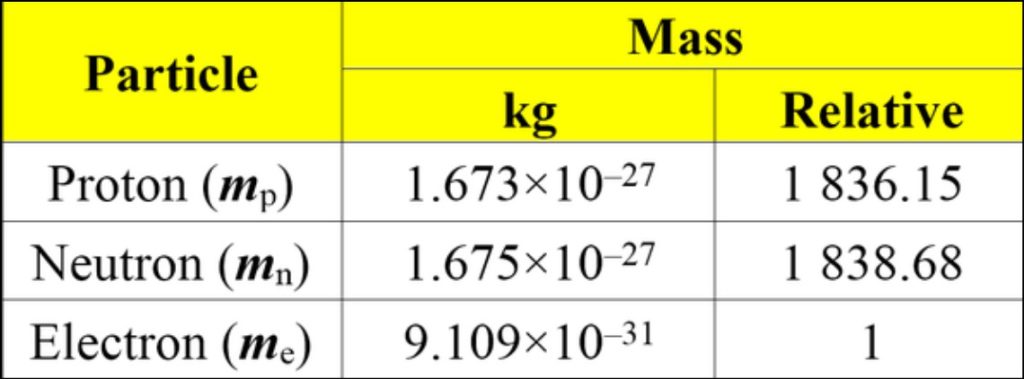
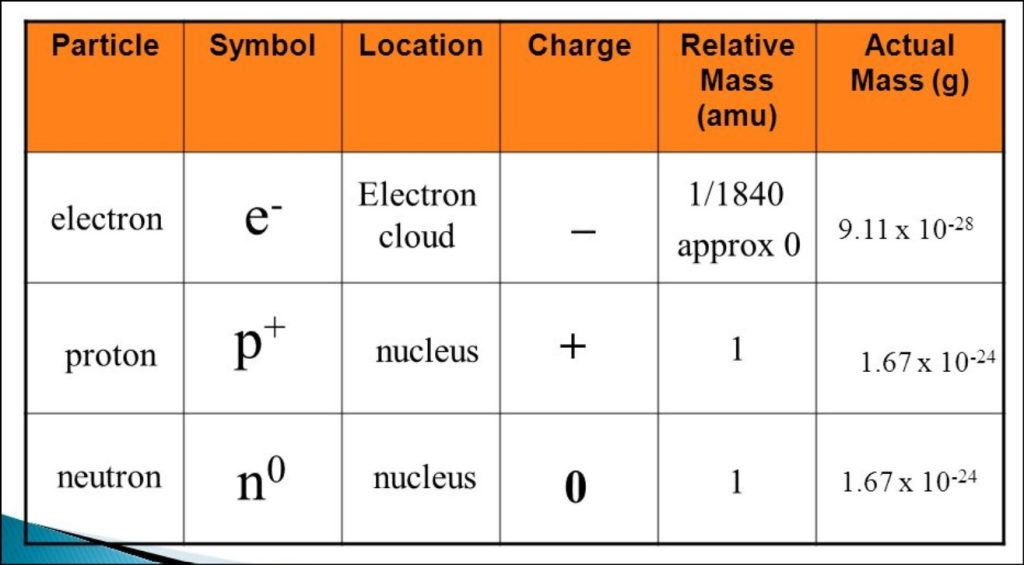
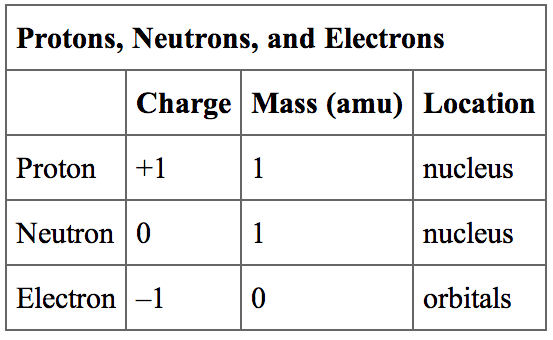
Protons, neutrons, and electrons are the three fundamental subatomic particles that make up atoms. They differ in mass, charge, and location within the atom. While protons and neutrons are found inside the nucleus and contribute almost all of an atom’s mass, electrons are much lighter and orbit the nucleus in electron shells.
|
Particle |
Relative Mass | Actual Mass (kg) | Charge | Location |
|
Proton |
1 amu | 1.6726 × 10⁻²⁷ kg | 1 |
Nucleus |
|
Neutron |
1 amu | 1.6749 × 10⁻²⁷ kg | 0 |
Nucleus |
| Electron | 0.00055 amu (≈1/1836 amu) | 9.109 × 10⁻³¹ kg | -1 |
Electron cloud (outside the nucleus) |
T
Key Facts About Proton, Neutron, and Electron Mass
- Proton mass: Approximately 1 atomic mass unit (amu) or 1.6726 × 10⁻²⁷ kg.
- Neutron mass: Slightly greater than a proton at 1.6749 × 10⁻²⁷ kg (about 1 amu).
- Electron mass: Only 9.109 × 10⁻³¹ kg, which is approximately 1/1836 of a proton’s mass.
- Protons and neutrons account for nearly 99.9% of an atom’s total mass.
- Electrons contribute a very small amount of mass and are not included in an atom’s mass number.
Mass of Electron in Grams
The mass of an electron in grams is approximately 9.109 × 10⁻²⁸ grams (or 0.0000000000000000000000000009109 g). Although this value is extremely small, it is one of the most important fundamental physical constants in chemistry and physics. Scientists use the electron’s mass to understand atomic structure, chemical reactions, electricity, and quantum mechanics.
Compared to other subatomic particles, the electron is much lighter. Its mass is about 1/1836 the mass of a proton and approximately 1/1839 the mass of a neutron. Because of this tiny mass, electrons contribute very little to an atom’s total mass, which is why the mass number only includes protons and neutrons.
The accepted SI value of the electron rest mass is:
- Mass in grams: 9.109 × 10⁻²⁸ g
- Mass in kilograms: 9.109 × 10⁻³¹ kg
- Mass in atomic mass units (amu): 0.00054858 amu
- Relative mass: 1/1836 of a proton
It is essential to remember that the gram is a unit of mass used for everyday objects, and the realm of subatomic particles requires more specialized units, such as kilograms or atomic mass units, to express their masses more conveniently.