Mass of a Proton Neutron and Electron: Understanding the mass of a proton, neutron, and electron is essential for anyone studying physics, chemistry, or the fundamental structure of matter. These three subatomic particles are the building blocks of every atom, with protons and neutrons forming the atomic nucleus and electrons surrounding it in energy levels. Their precise masses influence atomic stability, chemical reactions, nuclear energy, and the behavior of matter throughout the universe.
Whether you’re a student, researcher, or science enthusiast, learning the proton mass, neutron mass, electron mass, atomic particle mass, subatomic particles, atomic structure, and particle physics concepts provides a deeper understanding of how the universe works. In this guide, you’ll find an easy-to-understand comparison of the masses of these fundamental particles, along with their properties, differences, and why they are crucial in modern physics, quantum mechanics, and cosmology.
What is The Mass of a Proton Neutron and Electron?
Proton: The proton, one of the fundamental particles that make up the atom’s nucleus, along with the neutron. It carries a positive electric charge and is denoted by the symbol “p” or “p^+”. The mass of a proton, approximately 1.67262192 × 10^-27 kilograms (kg). In atomic mass units (u), a proton’s mass is approximately 1.00727 u. The proton’s mass was significant in determining the overall mass of an atom since it contributes significantly to the atomic mass.
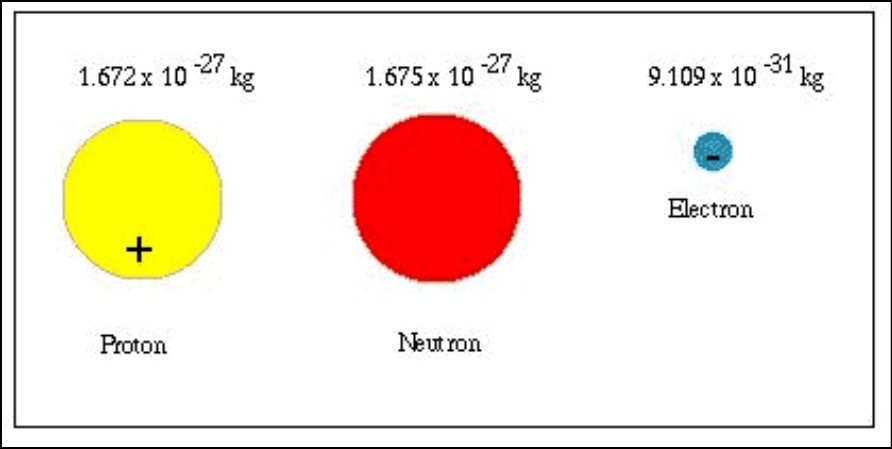
Neutron: A neutron is a fundamental subatomic particle found inside the atomic nucleus alongside protons. Unlike protons and electrons, neutrons carry no electric charge, making them electrically neutral. Represented by the symbol n, a neutron has a mass of approximately 1.674927471 × 10⁻²⁷ kg (1.00866 u), which is slightly heavier than a proton. Neutrons are essential for maintaining nuclear stability because the strong nuclear force binds protons and neutrons together, preventing the positively charged protons from repelling one another. Without neutrons, many atomic nuclei would be unstable, making them one of the most important particles in atomic structure, nuclear physics, and radioactive elements.
Electron: An electron is a negatively charged subatomic particle that moves around the atomic nucleus in regions called electron clouds or atomic orbitals. It is represented by the symbol e⁻ and has an incredibly small mass of approximately 9.10938356 × 10⁻³¹ kg (0.00054858 u), making it about 1,836 times lighter than a proton or neutron. Although electrons contribute very little to an atom’s overall mass, they play a critical role in chemical bonding, electricity, chemical reactions, and the formation of molecules. The arrangement of electrons determines an element’s chemical properties, reactivity, and ability to conduct electricity.
Comparison: Protons, neutrons, and electrons are the three primary subatomic particles that make up every atom, but they differ significantly in mass, charge, and function. A proton has a mass of approximately 1.67262192 × 10⁻²⁷ kg, while a neutron is slightly heavier at 1.674927471 × 10⁻²⁷ kg. In contrast, an electron has a much smaller mass of 9.10938356 × 10⁻³¹ kg, making protons and neutrons about 1,836 times more massive. While protons determine an element’s atomic number, neutrons provide nuclear stability, and electrons control chemical behavior, electrical conductivity, and bond formation. Understanding these differences is essential for learning atomic structure, chemistry, physics, and the fundamental principles of matter.
Small factual updates
|
Particle |
Mass (kg) | Mass (u) |
|
Proton |
1.67262192369 × 10⁻²⁷ | 1.00727647 u |
| Neutron | 1.67492749804 × 10⁻²⁷ |
1.00866492 u |
| Electron | 9.1093837015 × 10⁻³¹ |
0.00054858 u |
Proton Mass and Charge
The proton is a subatomic particle found in the atomic nucleus and plays a crucial role in defining the properties of chemical elements. It carries a positive electric charge of approximately +1 elementary charge, which equal to 1.602176634 × 10^-19 coulombs (C). This charge is denoted by “e” in physics equations and represents the smallest unit of electric charge. The proton’s charge fundamental in establishing the atom’s overall charge, as the number of protons in an atom’s nucleus determines its atomic number, defining the element’s identity.

In addition to its electric charge, the mass of a proton is significant in understanding the structure of matter. As previously mentioned, a proton’s mass is approximately 1.67262192 × 10^-27 kilograms (kg). This mass is essential for calculating the total mass of an atom, as protons contribute substantially to the atom’s overall mass, along with neutrons. Protons are held together within the nucleus through the strong nuclear force, which overcomes the electromagnetic repulsion between positively charged protons.
The concept of charge and mass of protons has implications beyond atomic structure. In high-energy physics and particle accelerators, protons are commonly used as projectiles due to their positive charge. When accelerated to high speeds, they can collide with other particles or nuclei. Leading to the discovery and study of various subatomic particles and fundamental forces.
Overall, the proton’s mass and charge critical characteristics that define its role in atomic structure, chemistry, and high-energy physics experiments. Understanding these properties is essential for unraveling the mysteries of the subatomic world and the universe’s fundamental building blocks.
Proton Neutron Electron Mass
The masses of protons, neutrons, and electrons are crucial pieces of information in understanding the structure of matter and the fundamental forces that govern the universe. As previously mentioned, the mass of a proton is approximately 1.67262192 × 10^-27 kilograms (kg), the mass of a neutron is about 1.674927471 × 10^-27 kg, and the mass of an electron is approximately 9.10938356 × 10^-31 kg. Comparing these masses, we can see that protons and neutrons have very similar masses, both being roughly 1836 times heavier than electrons.
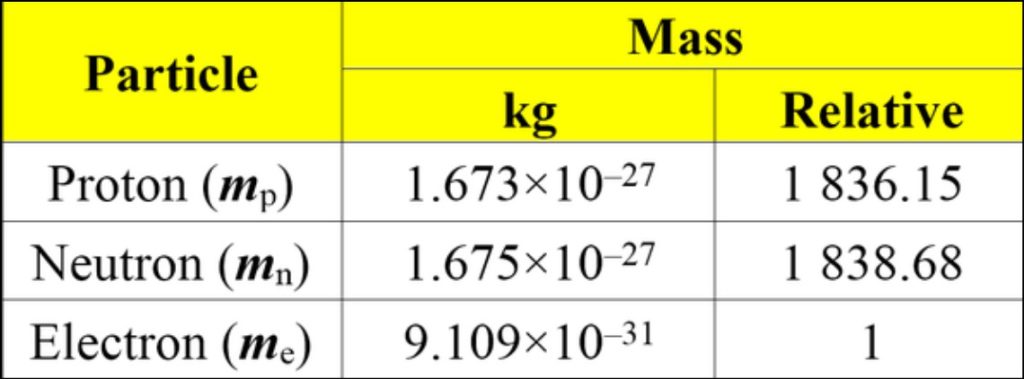
The mass of a proton and neutron is relatively large compared to the electron, and this difference in mass plays a vital role in determining the stability of atoms. The protons and neutrons in the nucleus contribute to most of the atom’s mass and are held together by the strong nuclear force, overcoming the electromagnetic repulsion between the positively charged protons.
In contrast, electrons, with their significantly smaller mass, orbit the nucleus in energy levels. These negatively charged electrons are bound to the positively charged nucleus by the electromagnetic force. The arrangement of electrons in different energy levels defines an atom’s chemical properties and determines how it interacts with other atoms to form molecules.
The study of particle masses also extends beyond the realm of atoms and molecules. Particle physicists use this knowledge to explore the subatomic world, including high-energy particle collisions and the existence of exotic particles like quarks, gluons, and neutrinos. Understanding particle masses is a crucial step in unraveling the mysteries of the universe and its fundamental building blocks.
Protons vs Electrons: Understanding the Building Blocks of an Atom
The mass of protons and electrons is a fundamental property that differentiates these subatomic particles. As mentioned earlier, the mass of a proton is approximately 1.67262192 × 10^-27 kilograms (kg). The mass of an electron is significantly smaller, around 9.10938356 × 10^-31 kg. This makes the proton approximately 1836 times more massive than the electron. The disparity in their masses is a crucial factor that influences the behavior of atoms and their chemical interactions.
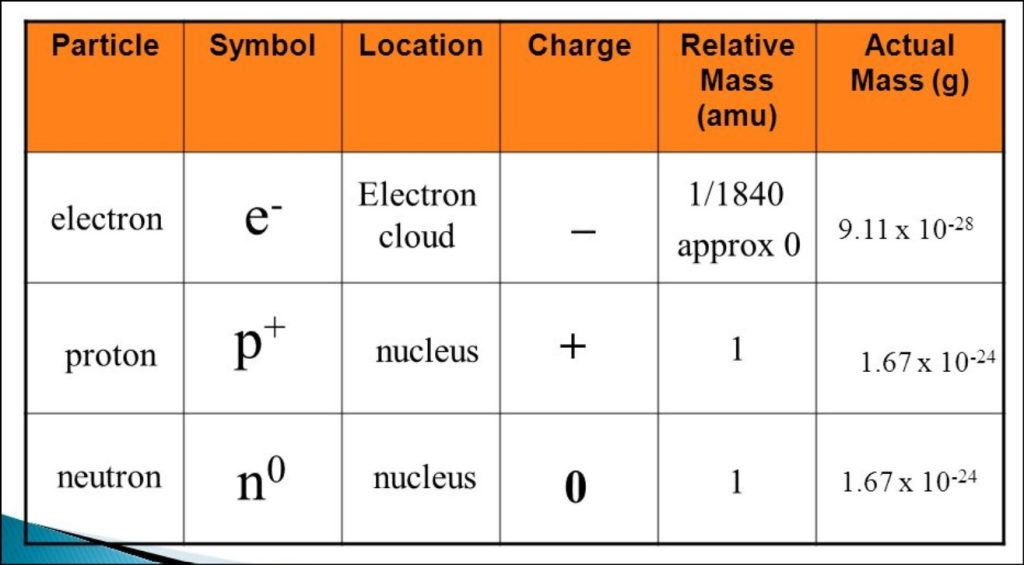
Protons and electrons are the two most important subatomic particles that define an atom’s structure and behavior. Protons, located in the nucleus, determine an element’s atomic number and unique identity on the periodic table. Electrons, on the other hand, move around the nucleus in electron shells (energy levels) and play a vital role in chemical reactions, chemical bonding, electricity, and the formation of molecules. The equal number of positively charged protons and negatively charged electrons keeps an atom electrically neutral and stable.
When calculating an atom’s atomic mass, the electron mass is so small that it is usually ignored. Instead, the atom’s total mass is determined almost entirely by the protons and neutrons packed inside the nucleus. This is why the atomic mass number is calculated using only these two heavier subatomic particles, making them the primary contributors to an element’s weight and nuclear stability.
Although extremely light, the mass of an electron is one of the most important constants in modern physics. It influences electron behavior, quantum mechanics, particle accelerators, atomic energy levels, and electromagnetic interactions. Scientists use the electron’s precise mass in particle physics experiments, advanced research, and theoretical models to better understand the fundamental laws of matter and energy.
In conclusion, the mass of a proton and an electron greatly differs, and this disparity has far-reaching consequences in the realm of atomic and particle physics. The mass of protons contributes to the overall mass of an atom, while electrons’ negligible mass allows them to participate actively in chemical processes and define the physical and chemical properties of elements.