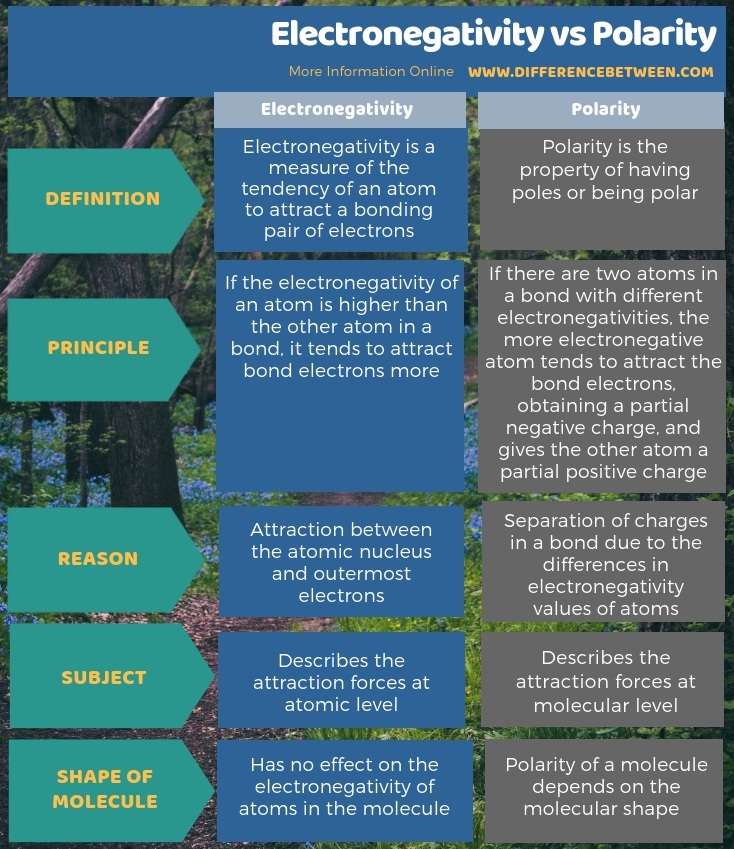
Difference Between Electronegative and Electropositive Elements: Electropositivity is the tendency of a chemical element to lose or donate valence electrons and form positively charged ions (cations). Elements with high electropositivity easily give away electrons during chemical reactions, making them highly reactive with nonmetals. This property is commonly found in alkali metals and alkaline earth metals, such as sodium, potassium, and calcium, which are located on the left side of the periodic table.
Difference Between Electronegative and Electropositive Elements
Electronegativity and electropositivity are two fundamental chemical properties that explain how elements behave during chemical bonding. While electronegativity measures an atom’s ability to attract shared electrons, electropositivity measures its tendency to donate electrons. Understanding the difference between these properties is essential for studying ionic bonds, covalent bonds, and periodic trends.
Every chemical element consists of atoms with a unique number of protons, neutrons, and electrons. The arrangement of valence electrons, atomic size, and nuclear charge determines whether an atom is more likely to attract or lose electrons. These atomic characteristics directly influence an element’s electronegativity and electropositivity, affecting its chemical reactivity and bonding behavior.
Electronegativity
Electronegativity is the ability of an atom to attract bonding electrons toward itself when forming a chemical bond. Elements with high electronegativity, such as fluorine, oxygen, and chlorine, strongly attract electrons, making them highly reactive nonmetals. Electronegativity plays a crucial role in determining bond polarity, molecular structure, and the type of chemical bond formed.
Several factors influence the electronegativity of an element, including atomic radius, effective nuclear charge, electron shielding, and the number of valence electrons. In general, electronegativity increases from left to right across a period and decreases from top to bottom within a group of the periodic table. Fluorine has the highest electronegativity, while cesium and francium are among the most electropositive elements.
In simple words, Electronegativity and electropositivity are opposite yet complementary concepts that help explain chemical reactions, ionic compound formation, electron transfer, and periodic trends. By comparing these two properties, students and chemistry enthusiasts can better understand why some elements gain electrons while others lose them, making it easier to predict chemical behavior and bond formation.
Electropositive
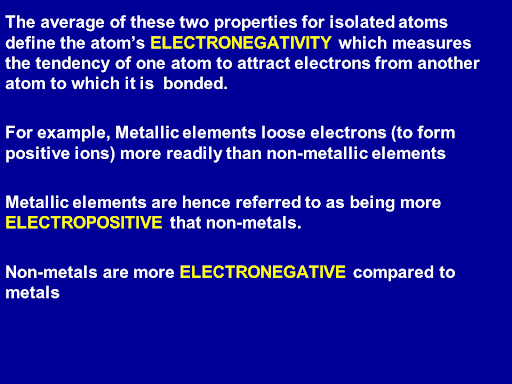
Almost all the metal elements around us are electropositive in nature, as they easily give away their electrons to orbitals in the outermost shell. Alkali is one such metal which has the highest electropositive properties.
Difference Between Electronegativity Vs Electropositive Chemical Elements
Both the terms Electronegativity and Electropositive have their own relevance, as one takes the electrons and the other gives it away to others.
Here is the simplified difference between both of these terms.
|
Electronegativity |
Electropositivity |
|
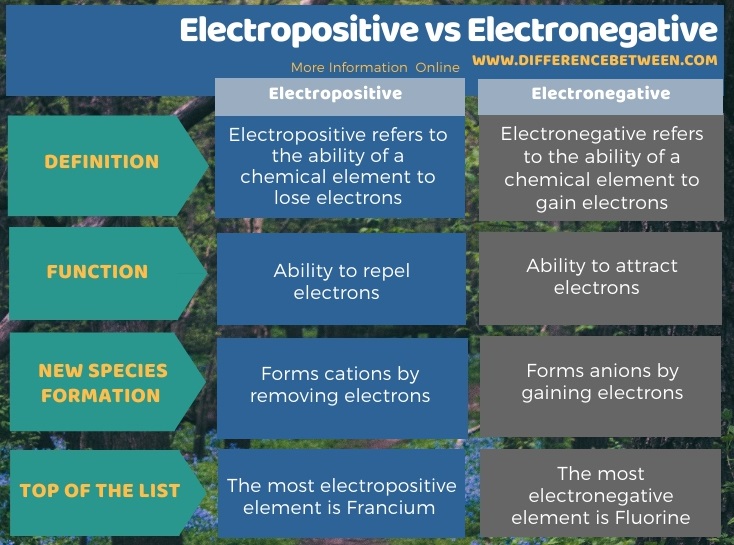
Electronegativity is the ability of an atom to attract shared electrons toward itself during a chemical bond. |
Electropositivity is the tendency of an atom to lose or donate valence electrons during a chemical reaction. |
|
Atoms with high electronegativity tend to gain electrons and often form negative ions (anions). |
Atoms with high electropositivity tend to lose electrons and form positive ions (cations). |
|
This property is commonly found in nonmetals, especially elements on the upper-right side of the periodic table. |
This property is strongest in metals, particularly alkali metals located on the left side of the periodic table. |
|
Electronegativity increases from left to right across a period and decreases down a group. |
Electropositivity decreases from left to right across a period and increases down a group. |
|
High electronegativity favors the formation of polar covalent and ionic bonds by attracting bonding electrons. |
High electropositivity promotes the formation of ionic bonds by readily donating electrons. |
|
Elements with high electronegativity generally have small atomic radii and high effective nuclear charge. |
Elements with high electropositivity generally have large atomic radii and low ionization energy. |
|
The Pauling Scale is commonly used to measure electronegativity. |
Electropositivity has no universally accepted numerical scale and is usually explained through ionization energy and metallic character. |
|
Fluorine (F) is the most electronegative element, with the highest value on the Pauling scale. |
Francium (Fr) is generally regarded as the most electropositive element (though cesium (Cs) is often used in practical comparisons due to limited experimental data on francium). |
|
Examples include Fluorine (F), Oxygen (O), Chlorine (Cl), and Nitrogen (N). |
Examples include Francium (Fr), Cesium (Cs), Potassium (K), Sodium (Na), and Calcium (Ca). |
| Electronegativity is essential for predicting bond polarity, molecular geometry, chemical reactivity, and electron distribution. |
Electropositivity helps predict electron donation, metallic reactivity, ionic compound formation, and reducing ability. |