If you’re studying chemistry, understanding the Manganese electron configuration is essential for mastering periodic table trends, chemical bonding, oxidation states, and electron distribution. Since manganese is one of the most important transition metals, it frequently appears in school exams, competitive exams, and higher chemistry courses.
In this comprehensive guide, you’ll learn the electron configuration of manganese (Mn), its orbital notation, valence electrons, electronic shell arrangement, and a simple step-by-step explanation that makes the concept easy to remember.
Manganese Electron Configuration
Manganese is one of the most important transition metals used across a wide range of industries due to its exceptional strength, durability, and chemical properties. This versatile chemical element plays a crucial role in the production of stainless steel, carbon steel, iron alloys, aluminum alloys, dry-cell batteries, fertilizers, pigments, glass manufacturing, and chemical catalysts. Its ability to improve hardness, wear resistance, and corrosion resistance makes manganese an indispensable material in modern manufacturing and engineering. Found abundantly in the Earth’s crust and extracted from minerals such as pyrolusite, manganese continues to support construction, automotive, energy, and infrastructure industries worldwide. Because of its extensive industrial applications and growing demand, manganese remains one of the most valuable and widely used elements in both commercial and scientific fields.
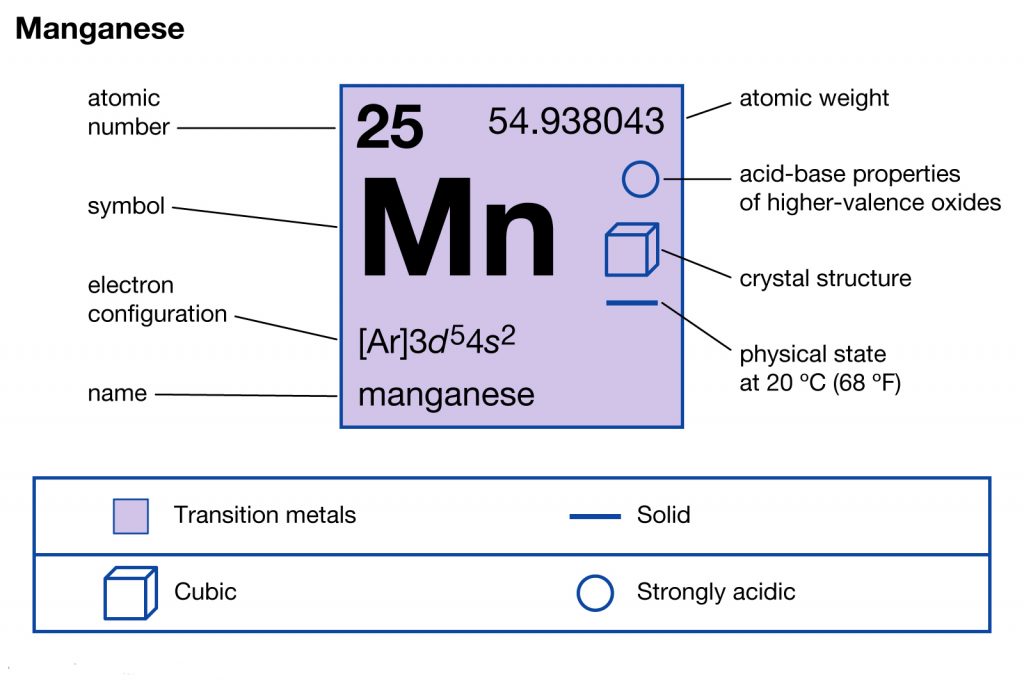
Understanding the Manganese electron configuration is essential for students, chemistry enthusiasts, and competitive exam aspirants because it explains how the 25 electrons of a manganese atom are arranged in different atomic orbitals. This electron arrangement plays a crucial role in determining the element’s chemical properties, oxidation states, magnetic behavior, bonding characteristics, and reactivity. Learning the electron configuration of manganese (Mn) also makes it easier to understand its position in the periodic table and its behavior as a transition metal.
The ground-state electron configuration of manganese is:
1s² 2s² 2p⁶ 3s² 3p⁶ 4s² 3d⁵
or, in noble gas notation,
[Ar] 3d⁵ 4s²
How many valence electrons does Manganese have?
The Manganese electron configuration is directly related to its atomic number (25), making it one of the most important concepts for understanding the element’s atomic structure and chemical behavior. Learning the electron arrangement of manganese (Mn) helps students understand how electrons are distributed among different orbitals, which explains its valence electrons, oxidation states, chemical bonding, and position in the periodic table. Whether you’re preparing for school exams, competitive exams like NEET or JEE, or simply exploring transition metals, mastering the electron configuration of manganese provides a strong foundation for understanding its physical and chemical properties.
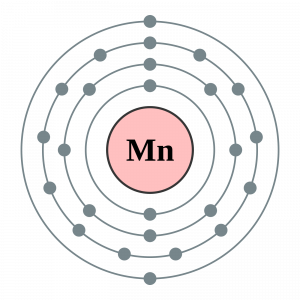
Electron Configuration for Mn
Well, if you are wondering about the derivation of the Mn electron configuration then you are at the correct place. Here in this section, we are going to simplify the whole derivation concept for the electron configuration of Manganese. You can easily understand the derivation concept in easy step-by-step formats.
- With the Aufbau principle, the first orbital has 2s, 2p, 3s, 3p, 4s, 3d, 4p, and so on electrons.
- Subsequently, the s orbital will contain 2 electrons, the p orbital will contain 2 electrons and then the s orbital will have the 10 electrons at max.
- At last, we will have the following equation of the electrons configuration for Manganese as 1s22s22p63s23p64s23d5.
So, this is how we will get our final equation for the Mn electron configuration. We believe this derivation technique would make it easier for you to understand the Manganese electron configuration. Feel free to share it with the other scholars of chemistry.
Frequently Asked Questions (FAQs)
Q: What is the electron configuration of manganese?
A: The ground-state electron configuration is:
1s² 2s² 2p⁶ 3s² 3p⁶ 4s² 3d⁵
or
[Ar] 3d⁵ 4s²
Q: What is the atomic number of manganese?
A: The atomic number of manganese is 25.
Q: How many valence electrons does manganese have?
A: Manganese has 7 valence electrons (4s² 3d⁵).
Q: What is the electronic shell configuration of manganese?
A: The shell distribution is:
2, 8, 13, 2
Q: Why is manganese’s electron configuration stable?
A: The 3d⁵ half-filled subshell provides extra stability because of its symmetrical electron arrangement and reduced electron repulsion.
Q: Is manganese a transition metal?
Yes. Manganese is a d-block transition metal located in Group 7 of the periodic table.