Looking for the Europium Electron Configuration with a simple explanation? You’re in the right place. This guide explains the complete electron configuration of europium, including its atomic number, electron arrangement, orbital notation, valence electrons, electron shell distribution, and its position in the periodic table. Whether you’re preparing for a chemistry exam, completing homework, or learning about the lanthanide series, this article provides clear and accurate information.
Europium (Eu) is a rare earth metal and a member of the lanthanide series in the periodic table. It has an atomic number of 63 and contains 63 electrons in its neutral state. Europium is known as one of the most reactive lanthanide elements, which is why it must be stored in airtight containers away from oxygen and moisture. The metal is soft enough to be cut with a knife and quickly tarnishes when exposed to air, making it unique among rare earth elements.
Europium Electron Configuration
The electron configuration of Europium is [Xe] 4f⁷ 6s², showing its stable half-filled 4f subshell that contributes to its distinctive chemical and magnetic properties. Discovered in 1901 and named after the continent of Europe, europium commonly exhibits +2 and +3 oxidation states in chemical compounds. Due to its exceptional luminescent properties, europium is widely used in LED lights, fluorescent lamps, television displays, lasers, anti-counterfeiting security features, and nuclear reactor applications. Despite its importance in modern technology, europium remains one of the less abundant rare earth elements found in nature.
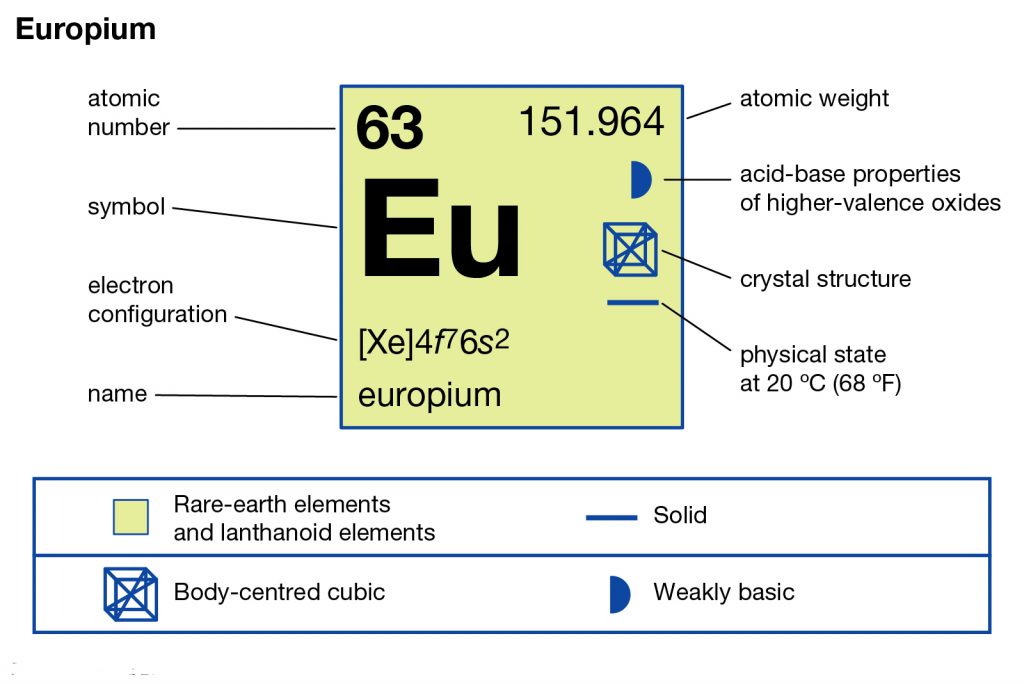
Understanding the Europium electron configuration is essential for learning how this rare earth element behaves in chemical reactions. Electron configuration explains how the 63 electrons of Europium (atomic number 63) are arranged in different energy levels, subshells, and atomic orbitals. This arrangement helps scientists predict the element’s chemical properties, oxidation states, magnetic behavior, and bonding characteristics. The electron configuration of Europium is [Xe] 4f⁷ 6s², which is the abbreviated noble gas configuration commonly used in chemistry. By studying its orbital diagram, electron notation, and electronic configuration, students can better understand where Europium fits in the lanthanide series of the periodic table.
Electron Configuration for Eu
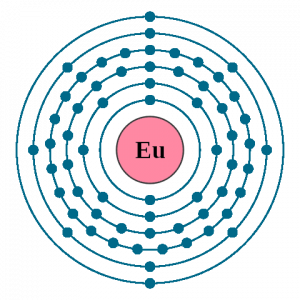
The Europium electron configuration [Xe] 4f⁷ 6s² follows the Aufbau principle, Hund’s rule, and the Pauli Exclusion Principle, making it an important example for chemistry learners. Knowing the electron arrangement also helps determine Europium’s valence electrons, electron shells, atomic structure, and its common +2 and +3 oxidation states. These characteristics influence its reactivity, magnetic properties, conductivity, and spectroscopic behavior. Whether you’re preparing for chemistry exams or researching the periodic table, understanding the electronic configuration of Europium provides valuable insight into this unique rare earth metal.
How many valence electrons does Europium have?
Although Europium (Eu) is one of the least abundant rare earth elements, it plays a significant role in several advanced technologies. Due to its rarity and high cost, Europium is mainly used in specialized applications such as LED displays, fluorescent lamps, television and smartphone screens, laser materials, anti-counterfeiting security inks, phosphors, and nuclear reactor control systems. Its outstanding luminescent properties make it an essential material in modern electronics and scientific research. As technology continues to evolve, the demand for Europium and its unique electronic characteristics is expected to grow, making it an increasingly valuable element in the future.
Some part of the chemical element is also useful to be used as the phosphor in the television sets. The screens of the TV contain some amount of Europium dioxide due to which the screen is one of the most expensive components of the television. The chemical element is although quite safe even in human exposure. So, this is all about the Europium electron configuration and the other properties of this element. Do share the article with others as well who want to study the Europium for their learning.