Looking for the Chromium electron configuration (Cr)? You’re in the right place. This guide explains the electron configuration of Chromium, its orbital diagram, noble gas notation, electron distribution, atomic number, valency, and position in the periodic table. Whether you’re preparing for NEET, JEE, GCSE, SAT, or other chemistry exams, this article provides everything you need in one place.
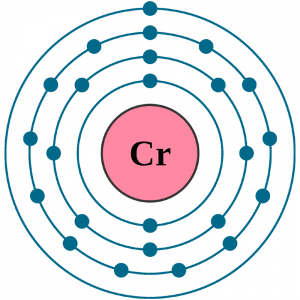
Chromium (Cr) is a transition metal with an atomic number of 24 and belongs to Group 6, Period 4 of the periodic table. Chromium is one of the most important elements in chemistry because it has an exceptional electron configuration that differs from the expected electron filling order. Understanding why Chromium has the electron configuration [Ar] 3d⁵ 4s¹ instead of [Ar] 3d⁴ 4s² is essential for learning atomic structure, chemical bonding, and periodic trends. In this article, you’ll also discover Chromium’s atomic properties, electron shells, oxidation states, physical characteristics, and real-world applications.
Chromium Electron Configuration
Chromium (Cr) is one of the most important transition metals in chemistry and is widely used in stainless steel manufacturing, metal plating, aerospace, automotive, and industrial applications. Known for its excellent corrosion resistance and strength, chromium plays a vital role in modern technology. If you’re searching for the Chromium Electron Configuration, Cr Orbital Diagram, or Noble Gas Configuration, you’ve come to the right place.
Electron Configuration: [Ar] 3d⁵ 4s¹
Chromium is a unique element because it is one of the few exceptions to the Aufbau Principle. Instead of the expected electron configuration [Ar] 3d⁴ 4s², chromium adopts the more stable configuration [Ar] 3d⁵ 4s¹, where the half-filled 3d subshell provides extra stability. This makes chromium a popular example in chemistry exams and competitive tests like NEET, JEE, SAT, and AP Chemistry.
Understanding the Chromium electron configuration helps explain how the element’s 29? (Correction: Chromium has 24) electrons are arranged within atomic orbitals, influencing its chemical properties, bonding behavior, magnetic characteristics, and industrial uses. Learning the Cr electron configuration, orbital diagram, electron distribution, and noble gas notation makes it easier to understand atomic structure and the behavior of transition metals.
What Is The Electron Configuration of Chromium?
So, with the same process, the electron configuration of the Chromium will actually be 1s22s22p63s23p44s23d9. This is the standard electron configuration of the Chromium after applying the election configuration formula.
How Many Valence Electrons Does Chromium Have?
Well, we believe that just knowing the answer of Chromium electron configuration in itself is not enough. Rather you should be aware of the actual derivation method of the answer. The derivation concept for the electron configuration brings clarity to scholars.
Chromium Number of Valence Electron
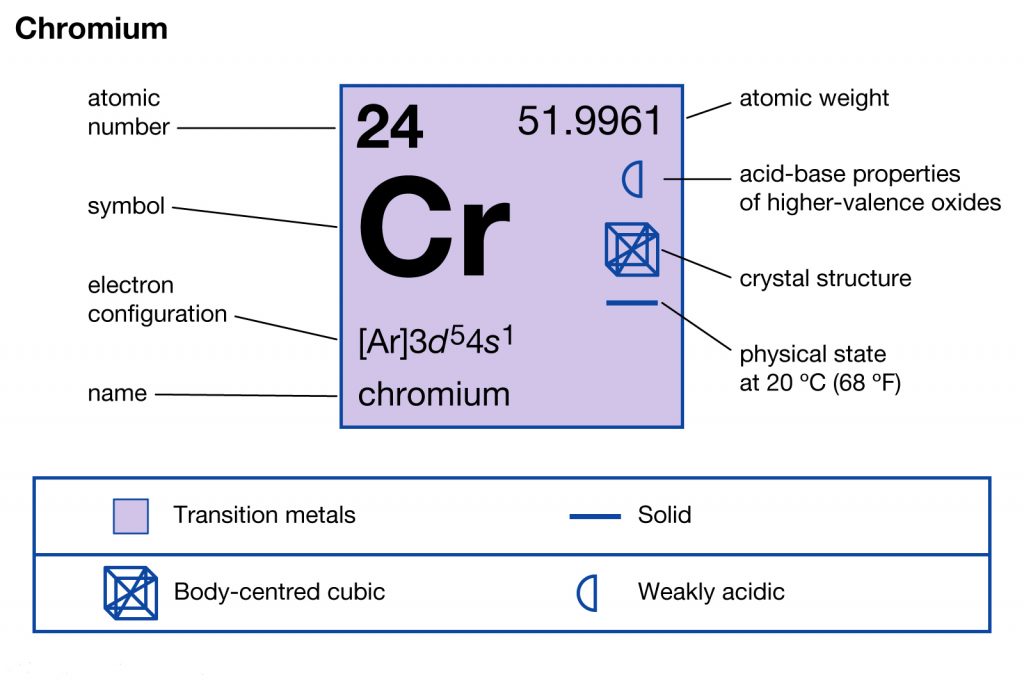
Chromium (Cr) has an atomic number of 24 and an unusual electron configuration compared to most transition metals. Instead of following the expected arrangement, chromium adopts a more stable configuration with a half-filled 3d subshell.
The electron configuration of Chromium (Cr) is:
1s² 2s² 2p⁶ 3s² 3p⁶ 3d⁵ 4s¹
or, in noble gas notation:
[Ar] 3d⁵ 4s¹
Chromium has 6 valence electrons because it has five electrons in the 3d orbital and one electron in the 4s orbital. This unique arrangement provides extra stability and is an important exception to the Aufbau Principle.
How to Write the Electron Configuration of Chromium
Follow these steps to determine the electron configuration of Chromium:
- Chromium has 24 electrons because its atomic number is 24.
- Fill the 1s orbital with 2 electrons.
- Add 2 electrons to the 2s orbital.
- Place 6 electrons in the 2p orbital.
- Fill the 3s orbital with 2 electrons.
- Add 6 electrons to the 3p orbital.
- Instead of the expected 4s² 3d⁴, one electron shifts from the 4s orbital to the 3d orbital.
- This creates the more stable electron configuration 3d⁵ 4s¹, giving Chromium a half-filled d subshell.
Final Electron Configuration of Chromium
1s² 2s² 2p⁶ 3s² 3p⁶ 3d⁵ 4s¹
Noble Gas Configuration: [Ar] 3d⁵ 4s¹
So, we hope this clarification of the Cr electron configuration will make sense to our scholars. They can also share the same information with their classmates or other friends.