Learn about Iodine valence electrons with this easy-to-understand guide designed for students, teachers, and chemistry enthusiasts. In this article, you’ll discover how many valence electrons iodine has, its electron configuration, Lewis dot structure, group number, atomic number, valency, and chemical properties explained step by step. Iodine (I) is a halogen element with atomic number 53 and belongs to Group 17 (Group VIIA) of the periodic table. Understanding iodine’s valence electrons makes it easier to learn chemical bonding, electron distribution, ionic and covalent bonds, and periodic table trends for exams and everyday chemistry studies.
How many valence electrons does Iodine have?
Iodine is a lustrous, purple-black, non-metallic chemical element with the symbol I and atomic number 53. One of its unique properties is that it sublimes easily, meaning it changes directly from a solid into a violet-colored vapor when gently heated. Iodine is the heaviest stable halogen and an essential trace mineral required by the human body. It naturally occurs in seawater, seaweed, seafood, dairy products, and iodized salt. Depending on chemical reactions, iodine exists in several oxidation states, including iodide (I⁻), iodate (IO₃⁻), and periodate (IO₄⁻).
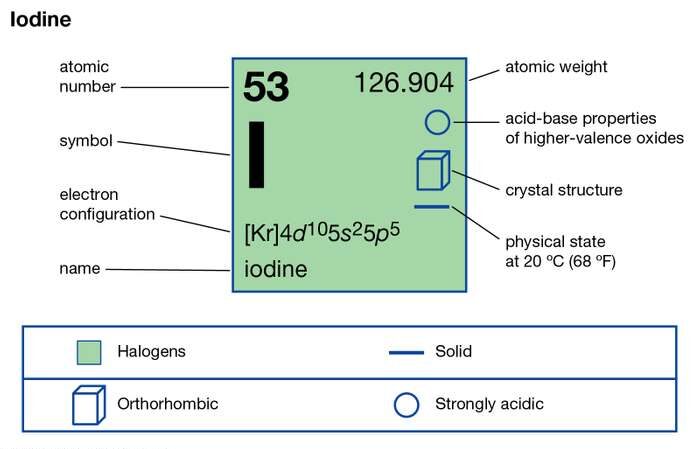
Iodine is best known for its critical role in thyroid health. The thyroid gland uses iodine to produce the hormones thyroxine (T4) and triiodothyronine (T3), which regulate metabolism, growth, brain development, and energy production. An iodine deficiency can lead to goiter, hypothyroidism, impaired cognitive development in children, and pregnancy-related complications. Because of these essential functions, iodine is widely used in dietary supplements, iodized salt, prenatal vitamins, and fortified foods to help maintain healthy thyroid function and overall well-being.
The food and nutritional supplement industry is one of the largest consumers of iodine, followed by the pharmaceutical, medical, and industrial sectors. According to global health organizations, iodine deficiency remains a significant public health concern, affecting approximately 2 billion people worldwide, particularly in regions with low iodine intake. Chile and Japan are among the world’s leading iodine-producing countries, supplying a large share of the global market. With growing awareness of thyroid health and preventive nutrition, the demand for iodine supplements, iodized salt, and iodine-rich foods continues to increase worldwide.
Iodine Valence Electrons Dot Diagram
Understand the exact numbers of Iodine valence electrons with the Lewis dot diagram. The diagram further represents the chemical binding of Iodine valence electrons.
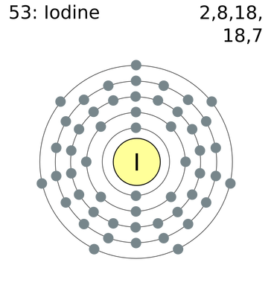
In this diagram, we basically draw the numbers of dots around the symbol of Iodine. The numbers of dots represent the numbers of valence electrons of atoms.
Valency of Iodine
The valency of Iodine remains -1 for most of its states. The chemical element has 7 electrons in the outer shell of energy. Hence Iodine gains 1 electron to attain the state of stability. Furthermore, Iodine is a member of group 17 in the periodic table
Leave a Reply